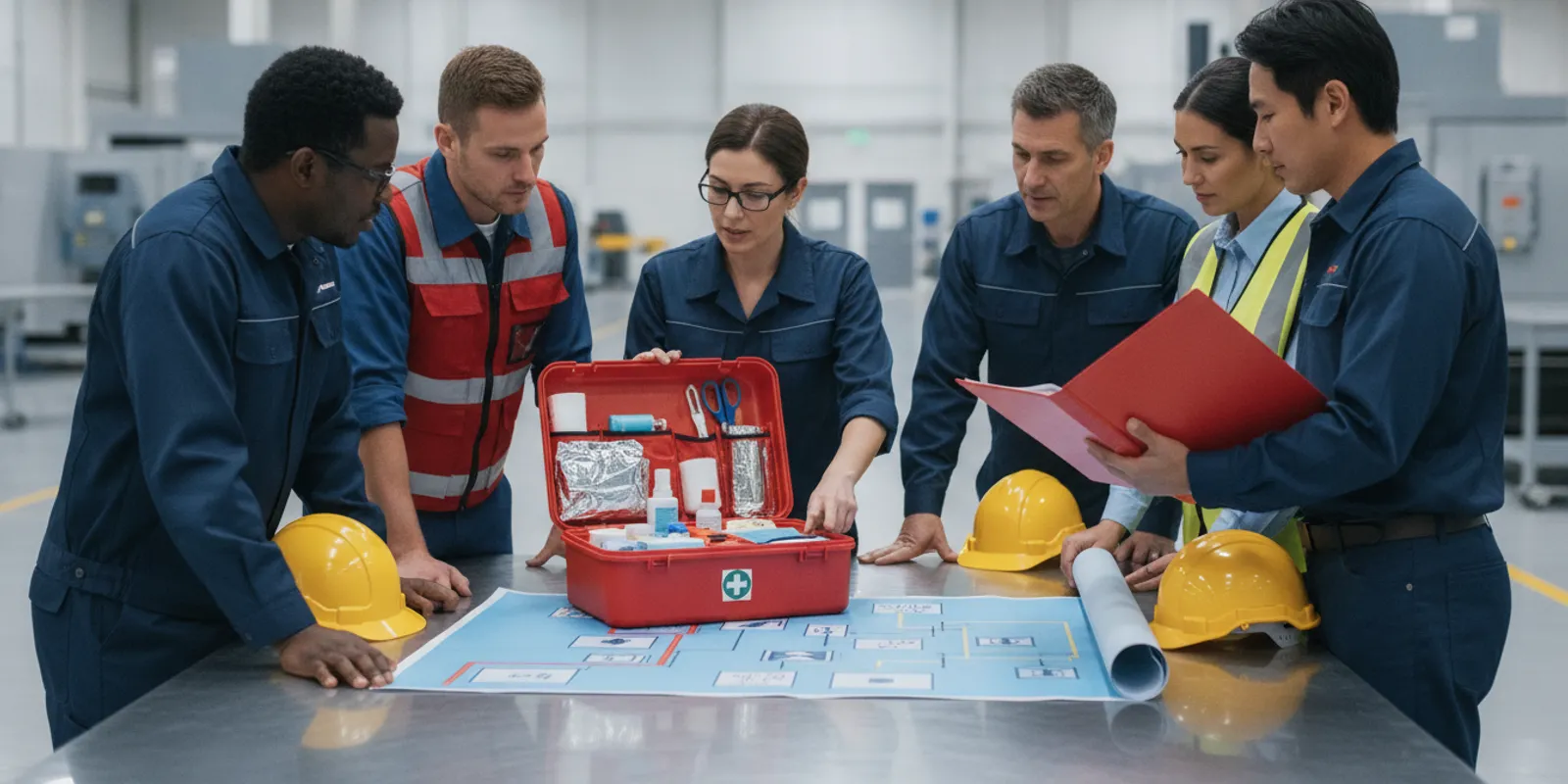
First aid training for workplaces helps employers prepare for injuries and medical emergencies before professional responders arrive. A useful program is more than sending one employee to a class. It connects trained responders, supplies, communication, documentation, and the employer’s emergency action plan to the hazards and layout of the worksite.
Discuss workplace safety training
When should an employer provide workplace first aid training?
Employers should begin with a site-specific question: if an employee is injured or becomes ill, can appropriate help arrive quickly enough for the worksite’s conditions? The answer depends on the worksite location, workforce, hazards, shift coverage, and access to emergency medical services.
OSHA’s Best Practices Guide: Fundamentals of a Workplace First-Aid Program describes first-aid planning as a combination of equipment, trained personnel, procedures, and communication. It also emphasizes evaluating the worksite rather than treating one course or one first-aid kit as a complete program.
Training deserves particular attention when a worksite has any of the following characteristics:
- Employees work far from a clinic, hospital, or other emergency medical resource.
- Work involves machinery, vehicles, heights, electricity, chemicals, heat, confined areas, or other serious hazards.
- Employees work alone, across multiple areas, or on rotating and overnight shifts.
- The organization operates construction, industrial, energy, transportation, utility, or remote field locations.
- Emergency access may be delayed by distance, weather, site security, traffic, or difficult terrain.
There is no single staffing formula that fits every employer. A small office near emergency services may need a different plan from a multi-shift construction project or a remote industrial crew. The employer should document the reasoning behind its coverage decisions and revisit them when the workforce, worksite, hazards, or emergency response times change.
What should a workplace first-aid needs assessment cover?
A needs assessment turns a general safety goal into a practical training plan. Walk through the worksite with supervisors, safety personnel, and employees who understand normal operations. Review both routine work and unusual events, such as severe weather, power loss, vehicle incidents, or a new project phase.
Worksite hazards
List the injuries and illnesses that could reasonably occur. A warehouse may focus on struck-by injuries, cuts, falls, and lifting incidents. A construction site may need to account for changing crews, mobile equipment, heights, and uneven access. An industrial or energy operation may need to consider machinery, chemicals, heat, confined areas, and remote locations. The purpose is not to predict every event. It is to identify the hazards that should shape training, supplies, and response procedures.
Time and distance
Record the normal route and likely response time for emergency medical services. Consider gates, access roads, elevators, site size, weather, and areas where a phone or radio may not work. If the site has several buildings or work zones, identify how a trained responder and emergency equipment can reach each area.
People and shifts
Map who is present during each shift, including temporary workers, contractors, supervisors, drivers, and remote crews. A plan that works during the day may leave a serious gap overnight. Identify primary responders and backups so that vacation, illness, turnover, and reassignment do not remove coverage.
Communication and access
Confirm how an employee summons help, who calls emergency services, how the site address is communicated, and who meets responders at the entrance. Post instructions where employees can see them. Make sure the method works in noisy areas, remote locations, and during a power or network interruption.
Employers can also review Patriot’s job hazard analysis resource when organizing a broader hazard review. First-aid planning should complement, not replace, hazard controls and required safety procedures.
Which first aid course should an employer choose?
Course selection should follow the needs assessment. A basic course may cover common first-aid actions, CPR, and automated external defibrillator awareness or use. A worksite with more serious or specialized hazards may need additional instruction tailored to those hazards. Employers should confirm what the course covers, how skills are practiced, how completion is documented, and when renewal is expected.
When comparing providers, ask these questions:
- Does the course address the hazards found at the worksite?
- Do participants practice skills in person, rather than only watching a presentation?
- Does the course include realistic scenarios and an opportunity for questions?
- Are completion records or certificates provided and easy to retrieve?
- Can the provider support different shifts, locations, or mobile crews?
- How are refresher training and renewal dates tracked?
- Can the instructor explain the limits of first aid and when emergency medical services must be contacted?
OSHA’s Medical and First Aid overview points employers toward workplace first-aid program guidance. Employers should use current regulatory requirements and applicable industry rules when deciding what training is needed. A course certificate by itself does not prove that the employer has adequate coverage, supplies, communication, or procedures.
How do course options compare?
The best option depends on the worksite’s risk profile and operating model. The following comparison can help an employer frame the decision before contacting a training provider.
| Option | Best fit | What to confirm | Program considerations |
|---|---|---|---|
| General workplace first aid | Lower-hazard offices and routine worksites with reliable emergency access | Core first-aid topics, hands-on practice, completion records | Review coverage by shift and keep supplies accessible |
| First aid with CPR and AED skills | Sites where cardiac or serious medical emergencies are a concern | In-person skill practice, equipment availability, renewal process | Coordinate responder locations, AED access, and emergency communication |
| Hazard-specific workplace training | Construction, industrial, energy, manufacturing, and other higher-risk operations | Relevant scenarios, procedures, and instructor experience | Match training to job tasks, work zones, and changing site conditions |
| Remote or field-workforce training | Crews working far from emergency services or across mobile locations | Remote response topics, communication methods, and practical limitations | Plan coverage, transport, supplies, check-ins, and escalation steps |
Do not select a course solely because it is convenient. A short, generic class may leave important questions unanswered for a remote crew or high-hazard operation. Conversely, a complex course may not be necessary for every employee. Many employers use a core course for designated responders and add focused instruction for supervisors or teams with special exposure.
How should employers organize trained responders?
Assign roles before an emergency occurs. Designated responders should know their responsibilities, the location of supplies, and the limits of their role. Supervisors should know how to activate the emergency plan and protect the scene. Employees should know how to report an incident and request help without delaying emergency care.
Consider these coverage principles:
- Cover every operating period. Review day, night, weekend, holiday, and overtime schedules.
- Use primary and backup responders. Avoid relying on a single person whose absence creates a gap.
- Place responders near the work. A trained employee who cannot reach a remote work zone promptly may not provide meaningful coverage.
- Account for turnover. Add training to onboarding and review coverage after transfers or resignations.
- Coordinate with contractors. Clarify who responds when several employers share a site.
- Protect privacy. Limit incident details and health information to people who need it for legitimate safety or compliance purposes.
Keep a current roster with names, work areas, shift coverage, training dates, and renewal information. Store it where supervisors can access it during an emergency, while following the organization’s privacy and record-control practices.
What supplies and equipment should support the training?
Training is more effective when employees can find and use the supplies that the plan anticipates. The correct contents depend on the worksite assessment, applicable requirements, and the hazards present. At a minimum, employers should identify where first-aid kits are located, who checks them, and how employees report missing or expired items.
Use a written inspection routine. The person checking a kit should record the date, location, condition, and replenishment needs. Inspect after an incident, after a major project change, and on a regular schedule appropriate to the worksite. Consider whether supplies remain accessible during locked-site conditions, severe weather, evacuation, or a change in work area.
Equipment planning may include first-aid kits, communication devices, emergency contact information, and other items selected for identified hazards. Specialized equipment should be included only when employees are trained and the employer has a clear procedure for its use. The goal is a usable response system, not a collection of items that no one can locate or operate.
For organizations coordinating several safety services, Patriot’s workforce compliance services page provides a starting point for reviewing broader compliance support. Employers should still confirm the specific first-aid resources and responsibilities that apply to each worksite.
How does first aid training connect to an emergency action plan?
First-aid response should fit inside the employer’s emergency action plan. The plan should explain how to report an emergency, request medical assistance, protect employees, direct responders to the scene, and account for people when the situation requires evacuation or relocation.
Write the sequence in plain language. For example, an employee may alert a supervisor or designated number, provide the location and nature of the emergency, avoid moving an injured person unless necessary for safety, and direct trained responders or emergency personnel to the scene. The exact steps must match the site and the organization’s procedures.
Run a short review or drill when practical. Ask employees to identify the emergency number, the location of the nearest first-aid kit, the route for emergency access, and the person who coordinates the response. Afterward, record what worked and what needs to change. A drill may reveal that a radio channel is unclear, a gate is locked, a kit is too far away, or a roster is out of date.
What should employers document?
Good documentation makes the program easier to maintain and demonstrate. Keep records that show how the employer selected training and maintained coverage. Depending on the organization’s policies and applicable requirements, records may include:
- The worksite needs assessment and the hazards considered.
- The course name, provider, date, participants, and completion records.
- Responder assignments by location and shift.
- First-aid kit and equipment inspection records.
- Emergency contact information and access instructions.
- Drill notes, corrective actions, and follow-up dates.
- Incident-related records maintained under applicable privacy and retention practices.
Use a central tracking method with reminders for renewals and periodic reviews. Documentation should be accessible to the people who manage safety, but it should not expose sensitive health information more broadly than necessary. Review the program after an incident, a near miss, a change in operations, a new worksite, or a change in emergency response conditions.
What changes for construction, industrial, and remote workforces?
Construction sites: Conditions can change from one phase to the next. Reassess responder coverage when crews move, subcontractors change, access routes shift, or a new hazard is introduced. Post the current site address and access instructions where supervisors and crews can find them.
Industrial and energy operations: Match training and supplies to the hazards identified in the job assessment. Coordinate first-aid response with site control rooms, permit processes, communication systems, and emergency shutdown or evacuation procedures where those procedures apply. Make sure responders can reach work areas without entering an unsafe scene.
Remote and mobile crews: Plan for distance and limited access. Confirm check-in procedures, communication coverage, location information, transport arrangements, and escalation steps. Training should help employees understand what to do while professional help is being arranged and what information to communicate.
Across all three settings, do not treat a certificate as the finish line. The employer must connect people, equipment, procedures, and communication in a way that works at the actual location and during the actual shift.
Frequently asked questions
Is one trained employee enough for a workplace?
Not necessarily. Coverage depends on the worksite, shifts, hazards, workforce size, and emergency response access. Employers should identify primary and backup responders for each operating period and work area where coverage is needed.
Does online instruction replace hands-on practice?
It may not address every skill or worksite need. Ask the provider how participants practice and demonstrate skills, and confirm that the course fits applicable requirements and the employer’s hazard assessment. Employees should also know how the training connects to the site emergency plan.
How often should first-aid training be renewed?
Follow the course provider’s renewal schedule and applicable requirements, then review skills when worksite hazards or procedures change. Refresher discussions, drills, and onboarding can reinforce the response plan between formal courses.
Where should first-aid kits be placed?
Place them where employees can reach them promptly and where the location remains known during changing operations. The needs assessment should account for distance, work zones, shifts, access controls, and hazards. Inspect kits regularly and after use.
Who should review the program?
A safety or operations leader should coordinate the review with supervisors, trained responders, and employees who understand the work. Include emergency response contacts when appropriate, and update the plan after incidents, drills, changes in work, or changes in access to medical services.
Explore occupational health support
A practical first-aid program gives employees a clear way to summon help, trained people a defined role, and emergency responders the information needed to reach the scene; review your plan regularly so it remains aligned with the work your team actually performs.