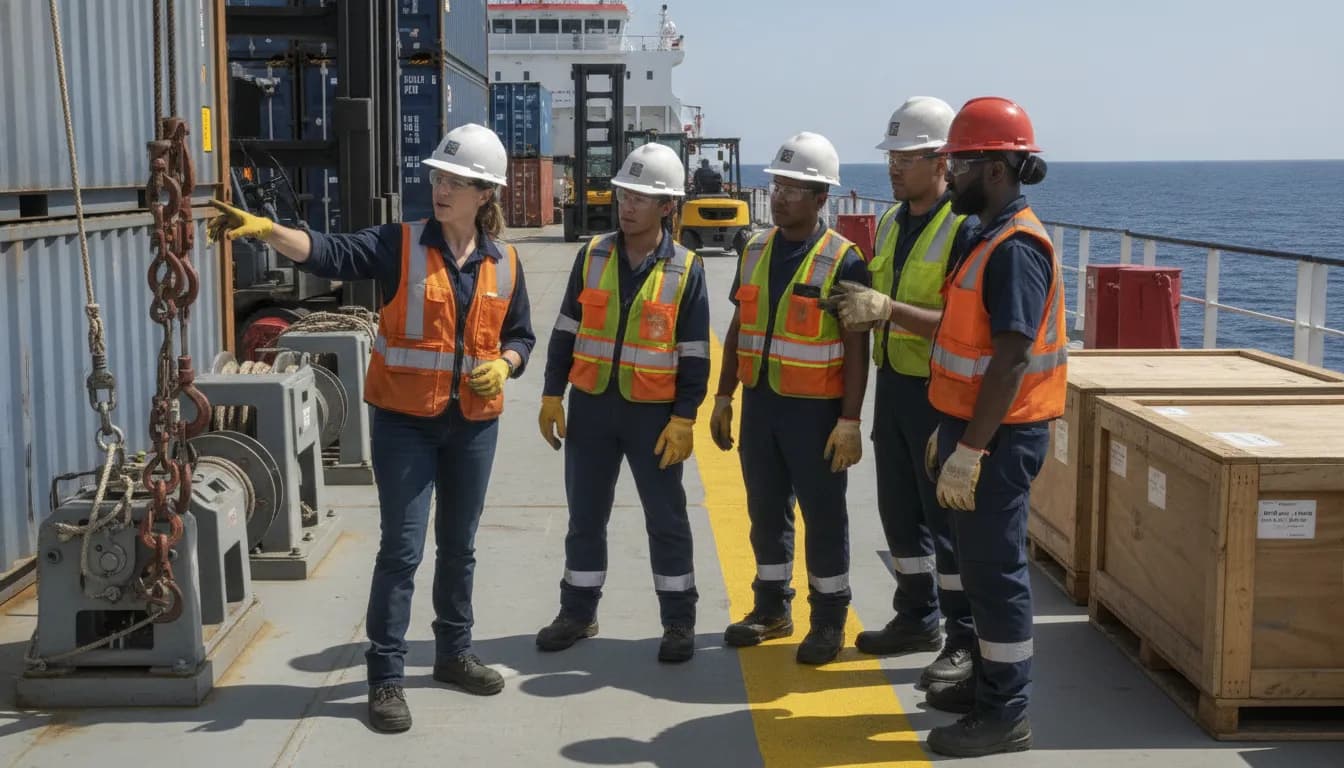
Maritime safety programs are easiest to defend when they are built around the work people actually perform, not copied from a generic checklist. A crew working aboard a vessel may face different exposures from employees loading cargo at a terminal, maintaining equipment, or entering a confined space.
Talk with Patriot Safety and Services about workforce compliance support
Effective maritime safety training for employers is a documented, role-specific program. It connects each worker's duties to the hazards, controls, emergency procedures, and governing requirements for the applicable vessel, worksite, and operation. OSHA identifies falls, equipment, chemical, confined-space, and fire hazards across maritime work. It also notes that controls, procedures, and training help raise hazard awareness and protect workers. Review OSHA's maritime overview alongside the rules that apply to your operation.
Start by defining the program's boundaries. Requirements can vary by worksite, role, vessel, activity, jurisdiction, and governing framework, while contractors and visiting crews may bring additional coordination needs. A clear coverage plan helps managers determine what every worker needs to know, what requires hands-on verification, and how training should be documented and maintained.
What Maritime Safety Training for Employers Should Cover
In brief: A sound program connects workplace hazards with practical controls and clear procedures. Training should fit each role, work area, and level of responsibility.
The scope of an employer program should follow the work, not a generic maritime checklist. Maritime operations can include vessel construction, repair, and scrapping, as well as the movement of cargo and other materials. Those activities may involve different equipment, work areas, crews, contractors, and supervisory duties. A person working around cargo movement may need different instruction from someone performing maintenance, entering a restricted area, or directing operations.
Start by identifying the tasks and conditions employees actually face. OSHA's maritime overview identifies hazards such as slips, trips and falls, machinery and equipment, hazardous chemicals, confined or enclosed spaces, and fire. That list is a useful starting point, but it is not a substitute for a site-specific assessment.
Employers should connect each hazard to the people exposed and the controls already in place. They should also identify the procedures employees must follow and the training needed to use those controls correctly.
Build the program around controls and procedures
Training is strongest when it explains what safe work looks like in the setting where the work occurs. Cover the purpose of relevant controls, the limits of those controls, required work practices, reporting expectations, and the actions to take when conditions change. Written procedures should be understandable to the employees who use them and specific enough for supervisors to verify performance.
Role differences matter throughout the program. New employees may need orientation to the work area, hazards, procedures, and reporting channels. Experienced employees may need task-specific instruction, updates after a process changes, or coaching when an observation reveals a gap. Supervisors and managers also need enough understanding to enforce procedures, recognize unsafe conditions, and confirm that training is being applied rather than merely completed.
Separate legal requirements from best practices
Some training topics and timing are established by an applicable regulation or standard. Others are employer controls adopted to address a hazard, satisfy a client expectation, or improve consistency. Those categories should be labeled separately in the training matrix and written materials. Requirements can depend on the vessel, activity, jurisdiction, worker role, and employer status, so employers should verify which rules apply before presenting a practice as legally required.
OSHA summarizes the relationship clearly: controls, procedures, and training help raise awareness of potential hazards and ways to keep workers safe. Use that principle to build a program that is documented, role-specific, and reviewed when work or conditions change, without claiming that one course covers every maritime operation.
Review OSHA's maritime safety overview when defining the initial scope and confirming which hazard areas require deeper, activity-specific guidance.
How Should Employers Assess Vessel and Port Hazards
Answer: Assess each task, transfer point, vehicle route, load, substance, and work area before assigning training, controls, and supervision.
| Work area or activity | Hazards to assess | Training focus |
|---|---|---|
| Vessel and dock access | Falls, access routes, changing work areas | Orientation, movement controls, reporting |
| Cargo loading and unloading | Heavy loads, suspended loads, machinery | Communication, equipment limits, line-of-fire controls |
| Terminal traffic areas | Powered equipment, trucks, pedestrians | Traffic routes, crossing rules, operator competency |
| Maintenance or enclosed spaces | Chemicals, machinery, confined-space hazards | Task procedures, PPE, authorization and emergency response |
A useful assessment starts with the way work actually moves through the operation. Marine terminals transfer cargo between ships, rail, and trucks. So the risk picture can change as a crew moves from a vessel to a dock, staging area, roadway, or warehouse. Map those interfaces rather than treating the terminal as one uniform workplace. This also helps employers identify where site orientation and task-specific instruction must differ.
Review loading and unloading activities in detail. The work may require powered equipment, cargo-lifting techniques, stowage decisions, and proper handling of hazardous materials. Ask who selects and operates the equipment, how loads are secured, where people stand during movement, and what communication method is used between operators and ground personnel. These questions turn a broad hazard list into training requirements that can be observed and verified. NIOSH identifies all of these elements as part of ship loading and unloading operations: cargo equipment, lifting and stowage techniques, and hazardous-material handling.
Traffic deserves its own review. Terminals are dynamic environments with powered industrial equipment, semi-trucks, passenger vehicles, and other moving equipment. Document pedestrian routes, crossing points, backing areas, blind spots, and times when traffic density changes. Then align the findings with controls such as designated travel paths, communication procedures, spotter expectations, and operator competency checks. Employers should not assume that a worker who understands one vehicle or one site is prepared for every terminal arrangement.
Assess exposure by task and location. Port and longshoring work can involve heavy lifting, repetitive motion, awkward postures, chemical exposure, enclosed spaces, dangerous machinery, and suspended loads. Moving containers and heavy bulk loads can also cause severe harm if workers enter the line of fire or if a load shifts unexpectedly. The assessment should identify the specific exposure, the people affected, the control used, and the training needed before work begins. For a repeatable way to break work into steps and controls, review these job hazard analysis steps.
Finally, convert findings into a role-based training matrix. A crane or equipment operator, deck worker, driver, maintenance employee, and supervisor may need different instruction even when they share the same site. OSHA notes that controls, procedures, and training help raise awareness of maritime hazards and ways to keep workers safe. Revisit the assessment when tasks, equipment, cargo, traffic patterns, or work areas change, and update training accordingly.
Build Training Around Emergency Response and Drills
Effective emergency training gives each worker a clear role, a known route, and practice responding to the alarms and systems they may encounter.
- Train at assignment and maintain proficiency. For shipyard fire-protection requirements, employers train new employees upon initial assignment and provide additional training when needed to maintain proficiency for previously trained employees. Apply that principle to the actual duties, spaces, equipment, and emergency responsibilities assigned to each worker. OSHA's maritime fire-protection standard provides the governing details for covered operations.
- Teach every alarm signal. Workers should know how to distinguish and respond to workplace emergency alarms, including system-discharge alarms and employee evacuation alarms. A drill is more useful when employees can recognize the signal, stop work, communicate, and follow the response plan without guessing.
- Walk the primary and secondary evacuation routes. Training should identify the primary route for a workplace fire and the secondary route where one is practicable. On vessels and vessel sections, the primary route must be established; a secondary route is not required when it is impracticable. Treat route knowledge as location-specific, especially when crews move between vessels, compartments, terminals, or changing work areas.
- Separate evacuation duties from fire-response duties. Not every employee has the same emergency role. Workers expected to fight incipient-stage fires need instruction on extinguisher and hose-line principles, associated hazards, and procedures that reduce those hazards. They also need training on fixed and portable fire-protection systems they may use or encounter. That includes systems the employer expects them to activate and operate.
- Put the response in writing. Maintain written standard operating procedures for anticipated emergency operations and update them as necessary. The procedure should align roles, alarm actions, evacuation routes, communications, equipment, and escalation decisions. New fire-response employees must be trained before participating in emergency operations, rather than learning their responsibilities during an active response.
- Record vessel drills and review what happened. A vessel drill program may include fire, lifesaving and survival-at-sea, emergency communications, and medical scenarios. For each exercise, retain the scenario, date, participating roles, observations, corrective actions, and responsible follow-up. Where senior officers develop drill protocols, maintain those protocols in an emergency-drill file or comparable controlled record. This creates a practical feedback loop between written procedures and actual crew performance.
For employers coordinating employees and contractors, the same records confirm who received the relevant orientation. They also show who has a response assignment and which issues need correction before the next operation.
How Do Employers Verify Role-Specific Competency
Answer: Employers verify competency by combining role-specific instruction, hands-on practice, qualified evaluation, and documented follow-up when equipment, conditions, or performance changes.
A course completion record is useful, but it does not by itself show that a worker can perform a task safely in the actual workplace. For powered industrial truck operators. OSHA places responsibility on the employer to implement a training program and permit only drivers who have successfully completed it to operate the trucks. The same principle is valuable for other maritime roles: define the work, train to the real conditions, observe performance, and retain evidence of the decision.
Combine formal instruction with workplace demonstration
Powered industrial truck training must combine formal methods, such as lectures or videos, with practical methods, including demonstrations and practical exercises. It must also include an evaluation of the operator's performance in the workplace. That evaluation should reflect the equipment, traffic patterns, surfaces, loads, visibility limits, and operating controls the worker will encounter, rather than relying only on a generic classroom test.
The curriculum should address both truck-related and workplace-related topics, along with the applicable OSHA requirements. For other jobs, employers can apply the same structure without assuming that one checklist fits every vessel or operation. A deckhand, cargo handler, maintenance worker, and confined-space entrant may need different demonstrations, controls, and acceptance criteria.
Use qualified trainers and defined refresher triggers
Training and evaluation should be conducted by a person with the knowledge, training, and experience necessary to train operators and evaluate competency. Employers should identify that qualified trainer in their records and use a consistent evaluation method. A simple pass or fail entry is stronger when paired with the task observed, equipment or role covered, date, and any corrective coaching.
Refresher training is not limited to a calendar date. OSHA's maritime powered-industrial-truck guidance identifies several triggers. They include unsafe operation, an accident or near miss, an evaluation indicating unsafe operation. Assignment to a different type of truck, or a workplace condition that changes and affects safe operation. These triggers also provide a practical review rule for other roles. Revisit competency after an incident, a meaningful change in equipment or duties, or evidence that the original training no longer matches the work.
Match PPE and controls to the working environment
Competency includes recognizing the conditions surrounding the task. A broader working-environment model considers chemical, physical, biological, ergonomic, psychosocial, and organizational factors. In maritime settings, that means PPE selection and work instructions should follow the hazards identified for the specific job, location, materials, and equipment. Where respiratory protection is part of the control strategy, employers should also review respirator fit testing requirements rather than treating PPE as a one-size-fits-all purchase.
This approach keeps maritime safety training for employers tied to demonstrated capability and changing workplace risk, without claiming that every vessel or job carries identical requirements.
Document Training and Coordinate Contractors
Answer: A defensible maritime training record connects each worker, role, vessel, task, instructor, evaluation, and follow-up action to a clear date and source document.
Good training is only useful to the employer if supervisors can verify who received it, what the training covered, and whether the worker was ready for the assignment. Build a training matrix by role and work location. Include onboarding, vessel familiarization, required policies and work instructions, equipment-specific instruction, emergency duties, drills, and refresher triggers. Keep the matrix current when a worker changes roles, joins another vessel, or moves to a different operating environment.
Make onboarding specific to the vessel and the work
General orientation should not replace site-specific familiarization. On arrival, workers should understand the vessel layout, assigned duties, access and egress points, communication expectations, restricted areas, and the procedures that govern their work. A shipboard safety program source identifies familiarization with the vessel and duties upon arrival as a core safety element. It also emphasizes adherence to policies, procedures, and work instructions during employment. Review those elements alongside your own vessel and employer requirements.
Record the orientation date, trainer, worker acknowledgment, materials used, and any unresolved questions. If a worker cannot demonstrate understanding, document the corrective coaching and verify completion before independent work begins.
Keep emergency and incident records together
Written emergency SOPs should address anticipated operations and be updated when equipment, vessels, assignments, or procedures change. For shipyard fire-response programs, OSHA specifically calls for written standard operating procedures that address anticipated emergency operations and are updated as necessary. Keep the current version accessible to supervisors, and archive superseded versions so an auditor can distinguish current instructions from historical records.
Record drills, training exercises, and safety meetings with the date, scenario or topic, participating crew, facilitator, observations, and assigned follow-up. Maintain written records for incidents and near misses, including the initial report, investigation, corrective actions, owner, and closure date. OSHA's maritime certificate program identifies accident and near-miss investigation as part of a safety and health system. That reinforces the value of treating these records as management inputs rather than isolated paperwork.
Use a consistent contractor handoff
Before a contractor boards or enters a work area, exchange the information needed to control interfaces. Include scope, hazards, vessel or site rules, emergency contacts, required qualifications, work instructions, and reporting expectations. Confirm who provides orientation, who leads the pre-job meeting, and who receives incident or near-miss reports. Document the handoff and retain attendance or acknowledgment records. These contractor safety management practices help keep responsibility clear when multiple employers share one operation.
Keep safety training records separate from drug-testing records. They serve different purposes and should not be presented as substitutes for one another.
What Should Employers Review Before Launching the Program
Answer: Before launch, employers should confirm that training matches each role, workplace hazard, emergency procedure. And applicable requirement, then establish records and a review trigger for incidents or changed conditions.
A strong maritime safety program is not a one-time orientation. OSHA identifies controls, procedures, and training as tools for improving hazard awareness, while written procedures should be updated when anticipated emergency operations or workplace conditions change. Use this pre-launch review to test whether the program is specific enough for the people and work they cover.
- Map the workforce, work, and applicable rules. List each role, vessel or facility, work activity, equipment, and level of responsibility. Confirm which requirements apply to the employer, location, vessel, contractor, and worker. Keep legal requirements separate from internal best practices so managers know what is mandatory and what is a chosen control.
- Connect each role to a hazard and training profile. Document the hazards employees may encounter and the controls they must understand. For every assignment, identify required knowledge, hands-on skills, supervision, personal protective equipment, and any prerequisites. Do not treat general awareness training as proof that a worker can safely perform a specialized task.
- Verify practical competency before independent work. Require qualified trainers or evaluators to confirm performance for equipment operators, emergency roles, and other safety-sensitive assignments. OSHA guidance for powered industrial trucks illustrates the principle: effective training combines formal instruction, practical exercises, and workplace-performance evaluation. Record who evaluated the worker, what was evaluated, and the result.
- Rehearse emergency responsibilities. Check that workers know alarms, reporting channels, evacuation routes, muster expectations, and the limits of their assigned response. Written standard operating procedures should address anticipated emergency operations and be updated as necessary. A drill should reveal gaps in communication, equipment, access, or role clarity, not merely create an attendance record.
- Coordinate contractors and site access. Decide how contractors receive orientation, vessel or facility familiarization, task-specific instructions, and handoff information. Confirm that supervisors can verify required training before a contractor starts work and that changes in scope trigger a new review. Employers seeking broader maritime compliance services should define that support separately from maritime instruction.
- Set the review cycle and refresh triggers. Audit training records, overdue assignments, competency evaluations, drill findings, and corrective actions. Refresh training after an unsafe observation, incident or near miss, failed evaluation, equipment change, or workplace-condition change. These triggers are specifically identified in OSHA's powered-industrial-truck guidance and provide a useful model for maintaining a living program.
Finally, assign an owner for the matrix, procedures, and records. A program is ready to launch when managers can show not only who attended training. But why the training matched the work and how the organization will respond when conditions change.
Request a workforce compliance consultation
Frequently Asked Questions
What are the OSHA standards for maritime safety?
There is not one universal OSHA rule that covers every maritime employer. Requirements depend on the work, such as shipyard operations, vessel repair, cargo handling, or terminal activities. Employers should identify the standards that apply to their hazards and use documented controls. Procedures, and training to address risks such as falls, machinery, chemicals, confined spaces, and fires. See OSHA's maritime overview for the relevant scope.
What should employers include in maritime safety training?
Training should reflect each employee's role and actual work environment. That may include vessel or terminal orientation, cargo and vehicle hazards, emergency alarms and evacuation routes, PPE, hazardous-material controls, and practical equipment evaluation. For powered industrial trucks, OSHA calls for formal and practical training, workplace-performance evaluation, and training by a qualified person. Refresher training may be needed after an incident, unsafe evaluation, equipment change, or workplace-condition change.
Where can employers find maritime safety courses?
Employers can begin with OSHA's maritime training resources and applicable OSHA standards. OSHA's Safety and Health Fundamentals Certificate in Maritime includes required and elective courses totaling at least 77 contact hours, including instruction on maritime standards, hazards, controls, and abatement. That certificate is an educational resource, not a substitute for site-specific orientation, task training, or an employer's own emergency procedures.
How should employers verify that crews and contractors are ready?
Use a training matrix that records role, required topics, completion, evaluation, and refresher triggers. Before work begins, provide vessel or site familiarization, confirm emergency responsibilities, and coordinate contractor handoffs. Keep written procedures and training records current, then use drills, safety meetings, observations, and near-miss reviews to identify gaps. The exact documentation and training duties depend on the work and applicable requirements.
Contact Us About Your Workforce Compliance Needs
A well-organized safety program depends on clear responsibilities, reliable documentation, and support that fits how your teams work. Patriot Safety and Services can help employers discuss workforce compliance support and broader employer safety program needs, while keeping maritime instruction within the appropriate scope. Contact us to discuss your current process, identify practical next steps, and determine where additional coordination may help your organization.