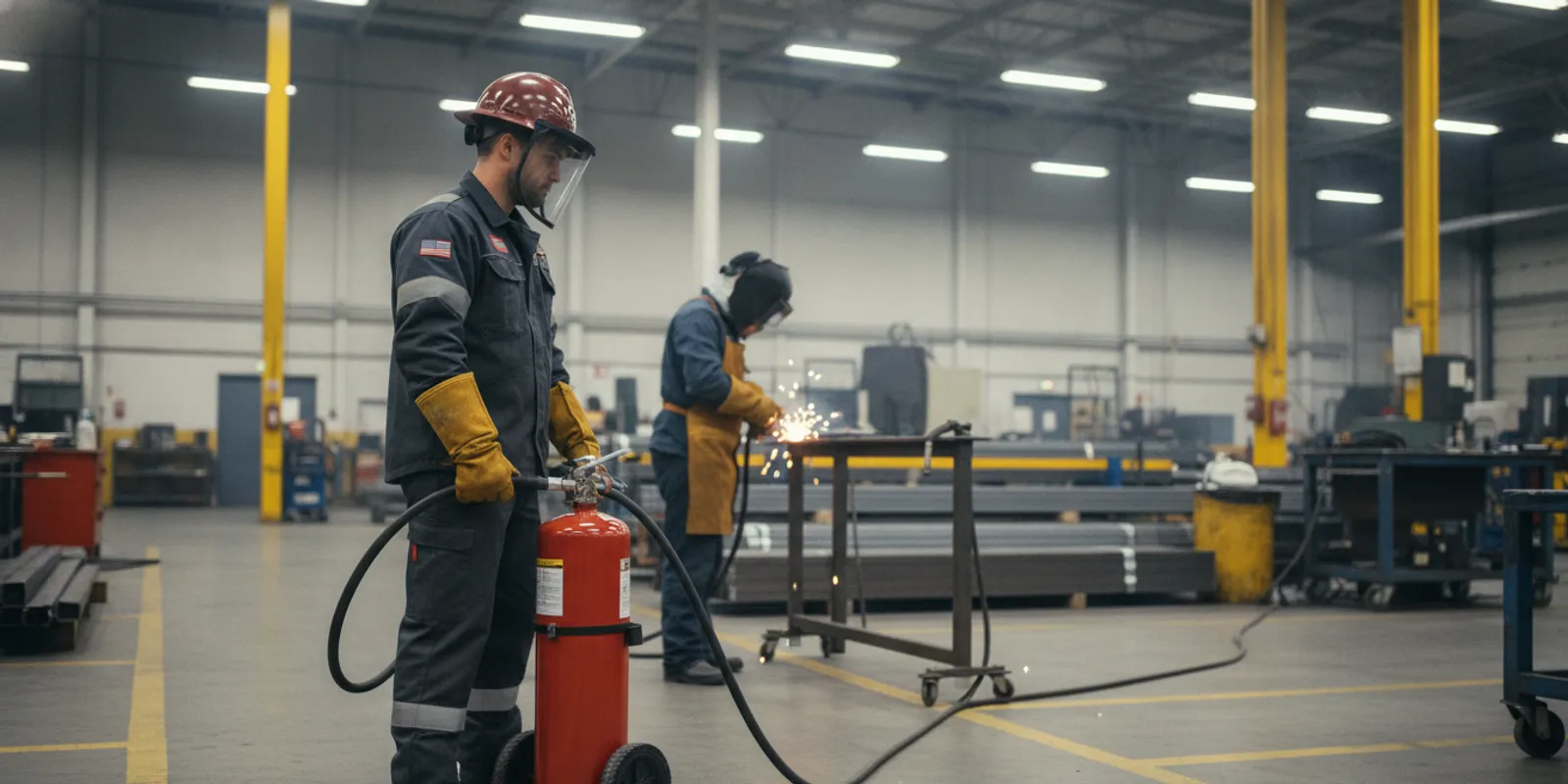
Fire watch training requirements matter whenever hot work can create a fire risk. Welding, cutting, brazing, grinding, torch work, and other spark- or heat-producing tasks can ignite nearby materials or send heat into concealed spaces. A designated fire watch is not simply someone holding an extinguisher. The person needs enough instruction, authority, equipment, and time to recognize hazards, communicate quickly, stop work when conditions change, and continue monitoring after the work ends.
Talk with a compliance specialist
This guide explains what employers should address when building or reviewing fire watch training. It focuses on the training and work controls around hot work. It is not a substitute for the requirements of the authority having jurisdiction, the applicable OSHA standard, a site safety program, or a permit issuer's instructions. The correct approach depends on the work, the facility, the materials present, and the hazards identified before the job.
What are fire watch training requirements?
Fire watch training requirements are the instructions and demonstrated competencies that enable an assigned employee to monitor hot work safely. At a minimum, training should connect the job's hazards with the fire watch's specific responsibilities. It should not be a generic presentation that leaves the worker unsure about what to watch, whom to notify, or when to stop the job.
For employers covered by OSHA's shipyard standards, the fire watch must be trained on required topics, and the employer must provide the training and equipment specified by the standard. OSHA's 1915.508 training requirements are a useful reference for the subjects a structured program should address. OSHA also describes the purpose and duties of fire watches in its fire watch guidance.
Other workplaces may be subject to different OSHA rules, adopted fire codes, client requirements, insurance conditions, or permit procedures. Employers should identify which requirements apply before assigning the role. A strong program then uses those requirements as a baseline and adds site-specific instruction for the actual work area.
Who needs fire watch training?
Anyone assigned to act as a fire watch needs training before performing that duty. The role may be filled by a worker from the performing crew, a safety employee, a supervisor, or another qualified person, depending on the employer's program. Job title alone does not establish competence. The employer should be able to show that the person understands the hazards, has been instructed on the equipment, and can carry out the response plan.
Training may be necessary for more than one person on a project. Consider the employee who watches the work, the person who authorizes or issues a hot-work permit, the supervisor who evaluates changing conditions, and anyone who may relieve the watch during a break. These roles are different, but they must coordinate. A replacement fire watch should receive a handoff rather than assume that the prior worker's observations are known.
Site-specific instruction is especially important when a worker is new to the facility, the work is performed in an unfamiliar area, the job involves multiple contractors, or the hot work is near walls, floors, ducts, tanks, decks, insulation, storage areas, or other locations where heat and sparks can travel. A person with prior training still needs an orientation to the location and the day's permit conditions.
What should fire watch training cover?
The curriculum should be practical and tied to the employer's hot-work process. The following subjects create a useful foundation.
Hot-work hazards and ignition sources
Workers should understand how the planned task can start a fire. Sparks can travel beyond the immediate work area. Conductive materials can carry heat. Slag and hot metal can fall through openings. Heat can pass through walls, floors, partitions, or structural members. A fire can also begin when combustible dust, gases, vapors, residues, packaging, rags, wood, insulation, or stored products are exposed to heat.
Training should explain the difference between visible conditions and concealed hazards. A clear floor around a welder does not prove that the space below or behind a barrier is safe. The fire watch should know which adjacent areas require inspection and whether another person must monitor a separate level or side of the barrier.
Combustible materials and area preparation
Before work begins, the assigned watch should understand how the area is prepared. This may include removing or protecting combustible materials, covering openings, controlling sparks, isolating nearby processes, checking the opposite side of a wall or partition, and maintaining access to fire-fighting equipment. The fire watch should know what the permit or job briefing requires and should not treat preparation as someone else's concern.
Training should also cover conditions that make hot work unacceptable. Examples include an unprotected opening, an unidentified residue, a flammable atmosphere concern, inadequate ventilation, missing equipment, or an area that cannot be monitored effectively. The worker needs clear authority to delay or stop the work and a defined escalation path.
Permit and authorization controls
A hot-work permit is a control document, not a replacement for active observation. Training should show the fire watch how to read the permit, confirm the work location, check the authorized time period, identify required precautions, and understand who approved the job. If conditions change, the permit may need to be paused, revised, or reissued under the employer's procedure.
Explain how the permit is displayed or made available, where completed permits are retained, and what information must be recorded. The watch should know whether a separate permit is needed for each area, shift, contractor, or task. A worker should never rely on a vague instruction such as “watch the welding” without knowing the boundaries and duration of the assignment.
Fire watch duties and limits
The fire watch's central duty is continuous observation of the hot-work area and nearby locations that could be affected. The person should watch for smoke, flame, glowing material, unusual odors, sparks leaving the control zone, heat transfer, and changes in surrounding conditions. The watch should also verify that barriers, screens, covers, and other controls remain in place.
Training must address distractions and competing assignments. A fire watch who is sent to perform another job, leaves to retrieve supplies, or focuses on a phone may miss a developing fire. Under OSHA's shipyard fire-watch rule, an employer must not assign other duties to a fire watch while hot work is in progress; the rule also addresses the fire watch's ability to observe and respond. Employers should review the applicable standard for their work and make the no-distraction expectation explicit.
The watch is not expected to enter an unsafe atmosphere or take on a response beyond the person's training. The program should define when to use an extinguisher, when to activate an alarm, when to call emergency services, and when to evacuate. Stopping the work and raising an alarm are successful safety actions, not failures.
Communication and emergency response
A fire watch needs a reliable way to contact the hot-work operator, supervisor, control room, site emergency coordinator, and emergency responders as appropriate. Training should cover radio channels, alarm points, telephone numbers, hand signals, backup communication methods, and the location of the nearest exit. The worker should know how to communicate the exact location and nature of a problem without delaying the alarm.
Use realistic scenarios during instruction. Ask what the worker would do if smoke appears on the other side of a wall, a spark lands in a lower level, the radio stops working, or the operator refuses to stop. The answers should be written into the site procedure or job briefing rather than left to improvisation.
Extinguisher readiness and other equipment
Training should identify the type, location, condition, and access route for the extinguishing equipment required by the job. The fire watch should be able to confirm that equipment is present, accessible, appropriate for the anticipated fire, and not blocked by tools or materials. The worker should understand the limits of portable extinguishers and never assume that one extinguisher makes an unsafe job acceptable.
If the employer authorizes first-aid fire-fighting, instruction should include the equipment's operating method, the safe approach, an exit route, and the point at which the worker must withdraw. Training should also cover any required protective equipment and the site's alarm or suppression systems. Equipment checks should be documented when the employer's procedure requires them.
How should employers structure the fire watch assignment?
Training is most effective when it follows a repeatable workflow. Before assigning a watch, the responsible supervisor or permit issuer should complete a hazard review and identify the area to be monitored. The review should consider the work above, below, behind, and adjacent to the hot-work location.
- Define the work. Record the task, location, equipment, start time, expected duration, and contractors or crews involved.
- Inspect the area. Identify combustibles, openings, concealed spaces, nearby operations, combustible construction, and access limitations.
- Set controls. Remove or shield materials, establish barriers, position equipment, and confirm ventilation and communications.
- Assign the watch. Name the responsible person, confirm training, explain the boundaries, and identify relief coverage if needed.
- Brief the crew. Review the stop-work signal, communication method, alarm procedure, and conditions that require reassessment.
- Monitor actively. Maintain the required observation during work and respond according to the emergency plan.
- Complete the post-work period. Continue monitoring for the time required by the applicable rule, permit, fire code, or site procedure.
- Close the permit. Document the inspection, observations, issues, corrective actions, and authorization to leave the area.
This workflow also supports contractor coordination. The hiring employer, host facility, and performing contractor should agree on who evaluates the area, who supplies the watch, who controls the permit, and who receives the completed records. Responsibility should be clear before work starts.
How long should a fire watch continue after hot work?
Post-work monitoring is essential because a fire may develop after the torch, arc, or grinder has stopped. Heat can remain in materials, and a smoldering condition may not be visible immediately. The required duration is not one universal number for every job. It should be based on the applicable OSHA requirement, fire code, permit, hazard assessment, and site procedure.
For example, OSHA's shipyard fire-watch guidance says to remain in the hot-work area for at least 30 minutes after the work ends, while the conditions of a particular job may require additional monitoring. Employers should verify the rule that applies to their operation rather than copy a time from an unrelated workplace. The watch should inspect the work area and affected adjacent spaces as directed, including areas where sparks or heat may have traveled.
The post-work period should be treated as an active assignment. The fire watch should not leave because the equipment is shut down or because the permit's work phase is complete. If the worker is relieved, the handoff should identify what was observed, what areas remain under watch, and when the monitoring period ends.
What should a fire watch training record include?
Documentation helps an employer demonstrate that the assignment was planned and that the worker received relevant instruction. A record should be understandable to someone reviewing it after an incident or during an audit. Depending on the employer's program and applicable requirements, include:
- The employee's name, employer, work location, and date of training.
- The instructor's name and qualifications or experience, when required.
- The topics covered, including hazards, duties, communication, equipment, emergency response, and post-work monitoring.
- The applicable standard, procedure, permit process, or site-specific briefing.
- Evidence of participation, such as an assessment, demonstration, sign-off, or documented discussion.
- The date, scope, or trigger for refresher training under the employer's program.
- Related permit numbers, area inspections, equipment checks, and corrective actions.
Training records should not stand alone. Keep them with, or make them traceable to, the hot-work permit and area inspection records. This connection helps show that the training was applied to a real assignment. Employers can also review Patriot's compliance resources when building a broader safety documentation process. Employers should retain records according to applicable law and their recordkeeping policy.
What should employers compare when reviewing a fire watch program?
A simple comparison can help employers identify gaps between a basic assignment and a defensible program. The exact controls still depend on the work and the rules that apply.
| Program element | Weak approach | Stronger approach | Evidence to retain |
|---|---|---|---|
| Hazard review | Only the immediate floor area is checked. | Adjacent, concealed, upper, lower, and opposite-side spaces are evaluated. | Area inspection or permit checklist |
| Fire watch assignment | A worker is named without confirming availability or training. | A trained person is assigned with clear boundaries, authority, and relief coverage. | Assignment and training record |
| Communication | The worker is told to find a supervisor if needed. | Alarm methods, contact points, location details, and backup methods are reviewed. | Job briefing or permit notes |
| Equipment | An extinguisher is assumed to be nearby. | Required equipment is identified, accessible, suitable, and checked before work. | Equipment or pre-job checklist |
| During hot work | The watch performs other tasks or leaves the area. | The watch observes continuously and stops work when controls fail or hazards change. | Permit observations or supervisor log |
| After hot work | The assignment ends when the tool is shut off. | Post-work monitoring continues for the required period and affected spaces are checked. | Permit closeout and monitoring record |
When is site-specific instruction necessary?
Site-specific instruction is necessary whenever general training does not explain the actual location, equipment, materials, or emergency plan. A refinery, fabrication shop, construction site, shipyard, warehouse, and utility facility can present very different pathways for fire and smoke. Even two work areas in the same building may require different controls.
Give additional instruction when the work involves unusual materials, confined or restricted access, multiple levels, energized systems, combustible dust, tanks or containers, fire protection impairment, weather exposure, or simultaneous operations. The employer should also reassess the assignment when the job changes, the work moves, a permit expires, a new contractor arrives, or an alarm or communication method becomes unavailable.
Site-specific instruction should be short enough to use before the job but detailed enough to be actionable. Point out the work boundary, nearby hazards, extinguisher locations, alarm points, exits, communication devices, and areas that require observation. Then ask the fire watch to repeat the response steps in their own words.
What common fire watch training gaps should employers avoid?
- Using attendance as proof of competence. A signature does not show that the employee can identify the work-area hazards or use the communication plan.
- Assigning a distracted worker. A person cannot safely monitor hot work while also performing production, cleanup, security, or other unrelated duties.
- Ignoring concealed spaces. Heat and sparks can travel through openings and assemblies that are not visible from the work position.
- Leaving authority undefined. The watch should know that work must stop when conditions are unsafe and how to escalate resistance.
- Ending the watch too soon. The post-work period should follow the applicable requirement and hazard assessment, not convenience.
- Failing to plan relief. A break, shift change, or long job can create an unmonitored gap unless a handoff is planned.
- Separating the permit from the training. The worker needs to understand the specific controls written for that assignment.
- Assuming one program fits every location. Regulatory, client, facility, and fire-code requirements may differ by job and jurisdiction.
Frequently asked questions
Can any employee serve as a fire watch?
An employee may serve only when the employer has determined that the person is trained, understands the assignment, can remain attentive, has the required equipment and communication method, and can respond within the limits of the program. The employer should also consider whether the person can see and reach the affected areas safely.
Does a fire watch need to know how to use an extinguisher?
The answer depends on the applicable rule and the employer's response plan. If the fire watch is expected to use portable equipment, training should cover the equipment, safe use, escape route, and limits of that response. No worker should be directed to fight a fire when conditions are beyond the person's training or when evacuation is the safer action.
Is a hot-work permit enough to satisfy training requirements?
No. A permit documents authorization and precautions for a job. It does not by itself demonstrate that the assigned fire watch understands the hazards, duties, communications, equipment, or post-work monitoring requirements. The permit and training record should support each other.
How often should fire watch training be refreshed?
Follow the refresher interval required by the applicable standard, company program, client, or authority having jurisdiction. Retraining or additional briefing is also appropriate when a worker shows a gap, an incident occurs, the work changes, or the person is assigned to an unfamiliar location or process.
Who should review a fire watch procedure?
The employer's safety or compliance leadership should coordinate the review with the responsible operations manager, permit issuer, supervisors, and other parties identified by the site program. Where required, involve the authority having jurisdiction or the facility's designated fire protection representative.
Explore workforce compliance services
How can employers make fire watch training usable?
A usable program combines regulatory review, practical instruction, site-specific briefing, active supervision, and complete records. Employers should identify the rule that applies, train the assigned worker on the actual hazards, provide the equipment and communication tools, define stop-work authority, and verify monitoring through permit closeout. Reviewing the program after a near miss or changed work condition can help keep fire watch training aligned with the risks employees face.
For help organizing workforce compliance processes, employers can contact Patriot Safety and Services to discuss their needs.
Fire watch training is strongest when every person understands the hazards, the boundaries, the response plan, and the responsibility to keep watching until the job is safely complete.