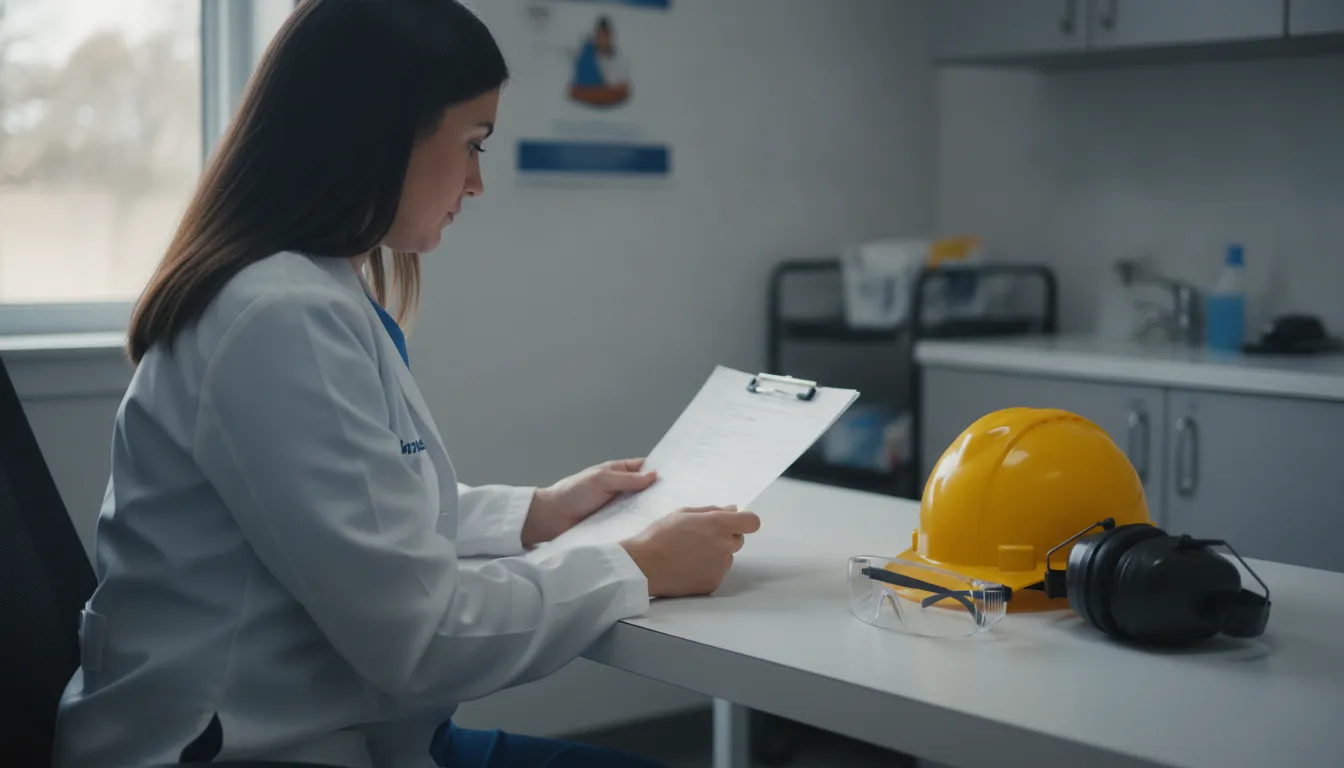
Occupational health screening for employers is the set of job-based exams and tests used to confirm a worker can do the assigned work safely. It is not one physical for every hire. A defensible program matches each component to the job, the hazard, and the rule that requires it, then keeps medical detail out of the personnel file.
The short version: build the program from the job description and the exposure, not from a clinic menu. Use a post-offer physical for essential functions. Add respirator, hearing, or exposure exams only when the hazard or the standard calls for them. Store the clinician's clearance apart from hiring records.
Request an occupational health screening plan
What Does Occupational Health Screening Include?
It includes only the exams tied to a real job demand or a named exposure, such as a post-offer physical, respirator medical clearance, a hearing test, or an exposure exam.
Start with the work, not the form. A warehouse selector who lifts cases all shift needs one kind of check. A welder in a noisy bay needs another. A driver who wears a half-face respirator during tank cleaning needs a third. Listing every available test looks thorough. It also creates records you may not be allowed to collect.
Patriot Safety and Services LLC builds this around the work the person will actually do. With 14+ years of experience and over 230 projects completed, the team matches screenings to field jobs in transportation, oil and gas, construction, manufacturing, mining, utilities, and healthcare. Services can be done on site or through a clinic network, which matters when a crew is spread across yards and plants.
A practical screen has five parts:
- The essential functions, written in plain job language.
- The hazards, such as noise, dust, respirators, driving, or heights.
- The rule that applies, if any, such as an OSHA standard or a DOT medical card.
- The timing: post-offer, before first use, baseline, periodic, or after a change in health or job.
- The result the employer may keep: a clearance, a restriction, or a need for follow-up.
Drug and alcohol testing is a separate program. Do not fold a drug panel into a medical exam just because both happen on day one. Background checks are a separate service line too. Keep them on their own forms and in their own files.
Which Exams Belong in Occupational Health Screening for Employers?
Include an exam when the job cannot be done without it, or when a standard says the employer must offer it. Leave out tests that only satisfy curiosity.
Use the table as a planning sheet. It shows the decision, not a medical protocol. Your safety lead and the clinician still have to match the row to the real task.
| Screening component | Include it when | Usual timing | What the employer keeps |
|---|---|---|---|
| Post-offer physical | The job has physical essential functions, and every person entering that job is examined. | After a conditional offer, and before the person starts. | Fit, fit with restrictions, or not fit for that job. |
| Respirator medical evaluation | The worker must use a respirator under the written program. | Before fit testing or first required use. Repeat when health, work, or the respirator changes. | Written clearance and any limits on respirator use. |
| Audiometric test | Noise exposure reaches the hearing-conservation action level. | Baseline first. Then at least once a year while exposure continues. | Test record, and whether a standard threshold shift occurred. |
| Exposure medical exam | A substance standard, such as respirable crystalline silica, requires surveillance. | Initial exam first. Then follow the schedule in that standard. | The clinician's written opinion for the employer, not the full chart. |
| Job-specific checks | The task needs a defined ability, such as acuity, color vision, or pulmonary function for respirator use. | With the physical or exposure exam that triggered the check. | Pass, fail, or a restriction against the job requirement. |
| Fitness-for-duty review | There is objective concern that a current employee cannot do the job safely. | When the concern arises. Limit the review to that concern. | Whether the person can do the job, plus any needed limits. |
Two rows are easy to overbuild. Vision and pulmonary function are tools inside another exam, not automatic add-ons for every new hire. A color-vision check belongs with a job that requires it. Spirometry belongs with a respirator or exposure question, and the meaning of the result stays with the clinician. For the test itself, see what a pulmonary function test measures.
DOT physicals are their own regulated exam for commercial drivers. If a role needs a medical card, send that person through the DOT process rather than stretching a general physical to cover it. The card rules live in the DOT physical requirements guide.
How Should Employers Time Pre-Placement Exams?
Make the job offer conditional first, then send every person entering that job through the same medical exam. Do not examine applicants before the offer.
The ADA draws a hard line. Before an offer, an employer may not ask disability-related questions or require a medical exam. After a conditional offer, the employer may require a medical exam if every entering employee in that job category takes it. During employment, an exam has to be job-related and consistent with business necessity, or required by another federal rule. The EEOC explains those stages in its guidance on preemployment medical examinations.
That sequence protects the company and the worker. A failed screen after a conditional offer can be tied to an essential function. The same screen before the offer looks like a disability inquiry. Write the essential functions before the clinic visit. Give the clinician those functions. Do not send a vague note that says "laborer, check if healthy."
Use the same exam for the same job. If only some hires in a category are sent for a back screen, the file will not show a business reason. It will show a selection. Different jobs can have different exams. A driver-laborer and an office coordinator should not share one form just because they start in the same week.
During employment, narrow the question. A supervisor who sees an unsteady gait on a ladder crew can request a fitness review aimed at climbing and balance. A request for a full annual physical, with no job change and no standard behind it, is harder to defend. Document the work problem you observed. Leave the diagnosis to the clinician.
When Is Respirator or Exposure Screening Required?
Respirator medical clearance is required before fit testing when a worker must wear a respirator. Exposure exams are required only when that substance standard says so.
OSHA's respiratory protection standard, 29 CFR 1910.134, says the employer must provide a medical evaluation before the employee is fit tested or required to use the respirator. A physician or other licensed health care professional uses the OSHA questionnaire or an exam that collects the same information. The employer then receives a written recommendation: any limits on use, whether follow-up is needed, and confirmation that the worker got a copy. The questionnaire answers stay with the clinician.
Give the clinician the facts that change the burden of the mask: respirator type and weight, how long and how often it is worn, the expected work effort, other protective gear, and heat or cold. Clearance is not the fit test. Fit testing checks the seal of a specific make and model, and it comes after medical clearance. The steps for that seal check are covered in the respirator fit test guide, and the written program around it is covered in respiratory protection program requirements.
Repeat the medical evaluation in three cases. The worker reports signs that may affect respirator use. A clinician, supervisor, or program administrator asks for another look. Or the conditions or the respirator change in a way that could raise the burden. Do not put every respirator user on a blanket annual exam unless the clinician or another standard calls for it.
Hearing tests follow a different trigger. Under 29 CFR 1910.95, a hearing conservation program is required when noise exposure equals or exceeds an 8-hour time-weighted average of 85 decibels. The program includes a baseline audiogram and an annual audiogram. How to monitor noise, choose protection, and train people is its own project, covered in the OSHA hearing conservation program guide. In this screening program, the decision is simpler: if the action level is met, audiometry is in. If it is not, do not add a hearing test to look complete.
Silica is the model for an exposure exam. General industry follows 29 CFR 1910.1053. Construction follows 29 CFR 1926.1153. Medical surveillance is tied to exposure at or above the action level. That level is 25 micrograms per cubic meter as an 8-hour time-weighted average, for the number of days the standard states. The exam content and the repeat interval belong to that standard, not to a generic physical form. OSHA's medical screening and surveillance guide indexes other substance rules, including lead, asbestos, and formaldehyde. Pull the exact paragraph before you promise a worker an exam schedule.
What Records Can the Employer Keep?
Keep the work decision. Do not keep the chart. The employer file should show clearance, restrictions, and the next due date, not diagnoses, questionnaire answers, or lab values.
Split storage into three places:
- Personnel or hiring file. The offer letter, the job duties, and a yes-or-no note that the person completed the required screen.
- Confidential medical file. The clinician's written opinion, restrictions, and exam dates. Limit access to people who need it for work accommodations, safety, or legal compliance. Keep it apart from supervisors' everyday files.
- Clinician or provider record. Histories, questionnaires, spirometry tracings, audiograms, and lab detail. OSHA exposure and medical-record rules can require long retention. Confirm the clock for each standard before anyone purges a file.
Tell workers what the screen is for, who sees the result, and what "not cleared" changes about the job. A surprise file shared with a foreman is how a sound program becomes a complaint. Patriot's occupational health visits are set up so the company receives the clearance it can act on, while clinical detail stays in the medical channel.
Track due dates the way you track training. A respirator user with no recorded clearance, or a hearing-conservation employee with no current audiogram, is a program gap even if the person feels fine. Review the roster when jobs change, not only at hire.
How Do You Choose Components by Job?
Group people by task, list the hazards, and check the matching rule. Then order only those components.
A short workshop with safety, operations, and HR is enough. Pull three job descriptions and mark each duty that is essential. Add measured or known exposures. Then tick the rows from the table above. The point is to leave a written reason for every exam you buy.
Here is how that looks on common Patriot job types, without turning one hazard into a full program manual:
- Construction crew around silica dust. Post-offer physical for the essential functions, plus silica medical surveillance if exposure meets the construction trigger. Respirator clearance and fit testing only if respirators are required. Hearing tests only if noise hits the action level.
- Oilfield or plant worker in a noisy unit. Post-offer physical, annual audiometry if the 85-decibel action level is met, and respirator clearance before any tight-fitting respirator is used. Pulmonary function is added when the clinician needs it for that clearance or exposure exam.
- Commercial driver who also loads freight. DOT physical on the FMCSA cycle for the driving duty. Add a separate job exam only for non-driving tasks the DOT exam does not cover. Do not treat the medical card as a general fitness file.
- Manufacturing technician with a half-face respirator. Medical evaluation first, fit test second, and a repeat when the respirator model, the work rate, or the worker's health changes.
Mobile collection helps when those jobs are not near a clinic. Patriot can send teams to a yard or plant for physicals, respirator fit testing, audiometric testing, and related screens, or schedule the same items through its clinic network. Either way, the components should stay the ones you justified.
If you are still deciding whether a site needs a full occupational health relationship or a narrower testing plan, the employer guide to occupational health covers the broader service. This page stays on the screening list itself. Employers around Midland can use the Midland occupational health guide for local scheduling questions.
Before the first clinic day, freeze four decisions in writing. Name who is in each job category. List which components each category gets. Record where the medical file lives, and who may see a restriction. Those four lines are what a later auditor, or a later supervisor, will ask for.
See Patriot occupational health services
Frequently Asked Questions
What does an occupational health screening consist of?
It consists of the exams required by the job and the hazards. That often means a post-offer physical, and it can include respirator clearance, a hearing test, or an exposure exam. It should not include every test a clinic offers.
Can an employer require a physical before making a job offer?
No. Disability-related questions and medical exams wait until after a conditional offer. After the offer, use the same exam for everyone entering that job category. During employment, limit exams to a job-related need or a specific legal requirement.
Is a respirator fit test the same as medical clearance?
No. Medical clearance comes first and asks whether the person can wear the respirator. The fit test comes next and checks the seal of a specific respirator. One does not replace the other.
Who should see the medical results?
The employer should see the work decision: cleared, restricted, or not cleared, plus any follow-up the clinician requires. Diagnoses and questionnaire answers stay in the confidential medical file or with the clinician. Supervisors need the restriction, not the chart.
How often should screenings be repeated?
Follow the rule that created the exam. Hearing tests in a conservation program are repeated at least annually. Respirator evaluations are repeated when health, the job, or the respirator changes. Silica and other substance exams follow the interval in that standard. A general physical has no single federal repeat cycle.
Build the Screening List Before the Clinic Visit
A useful program is a short list with a reason next to each line. Match the exam to the duty, schedule it at the right stage of hiring or exposure, and keep the medical detail in the right file. Patriot Safety and Services LLC can coordinate the physicals, respirator clearance and fit testing, audiometric testing, and exposure-related visits on site or in clinic, once that list is set.