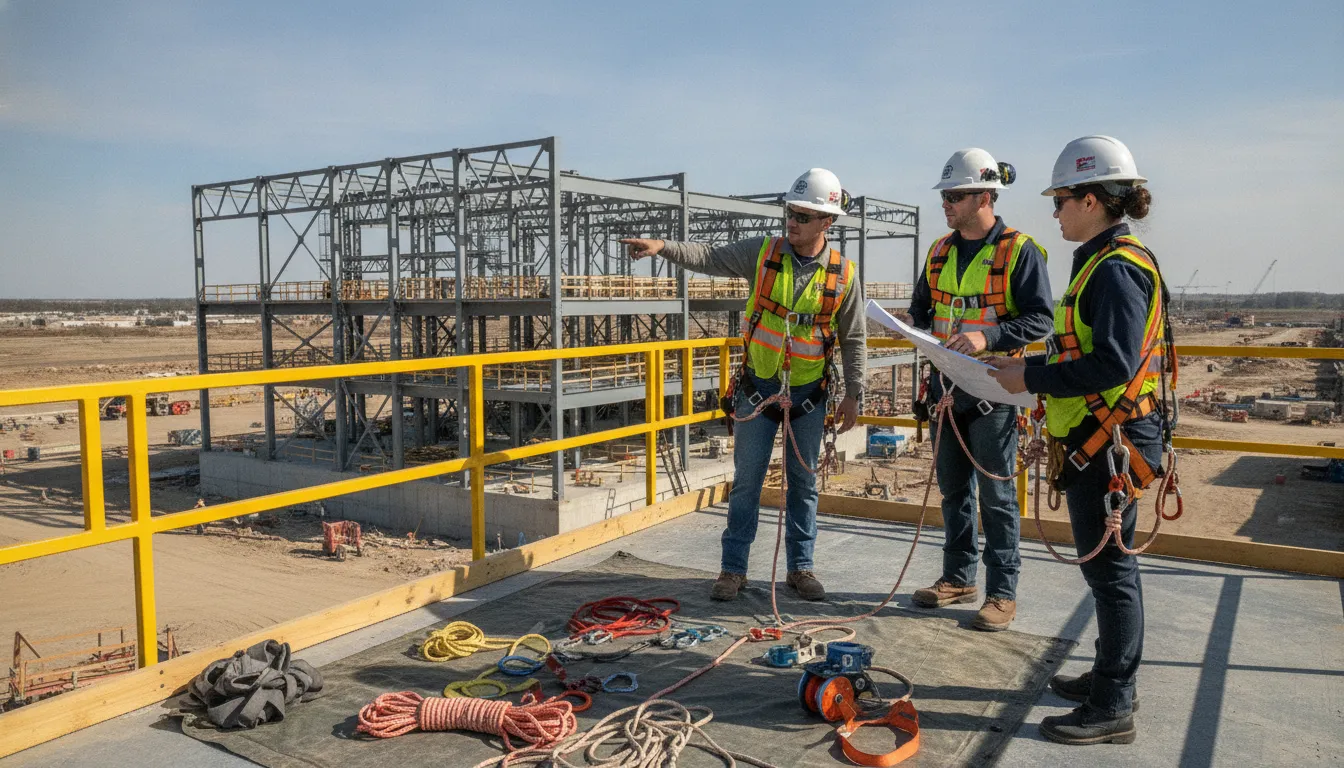
A fall protection rescue plan tells a work crew what to do when someone falls, becomes suspended in a harness, or cannot reach a safe surface without help. A complete fall protection rescue plan identifies the likely rescue method, equipment, trained rescuers, communication steps, and coordination with the site's emergency action plan before elevated work begins. After a fall, employers also need a documented response for medical care and testing. A post-accident drug testing program covers the time windows, procedures, and records that apply when an incident triggers testing.
Fall arrest equipment is important, but it does not finish the safety process. Employers also need a realistic way to reach a suspended worker promptly, protect rescuers, preserve access for emergency responders, and account for changing site conditions. The plan should be specific to the jobsite, reviewed by qualified and competent persons as applicable, and practiced before an incident occurs.
Talk with Patriot about workplace safety needs or call (432) 253-8958
What is a fall protection rescue plan?
A fall protection rescue plan is a written, site-specific procedure for retrieving a worker after a fall or enabling that worker to reach safety without creating another hazard. It is more than a generic statement that someone should call 911. It connects the fall protection system to the people, equipment, access routes, and decisions needed after a fall.
The plan should begin with a task and location review. Identify where workers could fall, how far they could be suspended from a safe landing area, what structures or equipment can reach them, and whether a rescuer can approach without entering an unprotected fall zone. Consider roofs, leading edges, structural steel, scaffolds, aerial lifts, towers, tanks, bridges, and other elevated work areas separately. A method that works on a low roof may not work on a tower or inside a shaft.
For each exposure, document the preferred rescue method, a backup method, the people authorized to perform it, and the equipment that must be staged or immediately available. Include the address or site coordinates, gate and access information, landing zones, overhead obstructions, utility hazards, and any restrictions that could delay a fire department or emergency medical response. If the job changes, the plan must change with it.
Rescue planning also helps employers decide whether a personal fall arrest system is the right control for a task. A system that stops a fall but leaves a worker inaccessible is not a complete solution. The goal is to prevent a fall where possible, arrest a fall when prevention is not enough, and make recovery prompt and controlled if an arrest occurs.
What does OSHA require for fall rescue?
OSHA requires employers to provide for prompt rescue after a fall or ensure that employees can rescue themselves, and the plan must fit the work and fall protection system in use. The construction rule is in 29 CFR 1926.502(d)(20). General industry requirements for personal fall protection systems include comparable language in 29 CFR 1910.140(c)(21).
These provisions do not prescribe one rescue device or one universal response time for every site. They require an outcome: a worker who has fallen must be rescued promptly, or the system and work method must allow effective self-rescue. Employers should be able to explain how the selected method works at the actual location, who will perform it, and what happens if the preferred method is unavailable.
OSHA's construction standard also requires personal fall arrest systems that have been subjected to impact loading to be removed from service until a competent person determines that they are undamaged and suitable for reuse. Equipment inspection and rescue are connected. After a fall, isolate the system, protect the scene, provide medical evaluation, and preserve equipment for inspection. Do not return an impacted harness, lanyard, connector, lifeline, or anchor component to service based only on a visual glance.
| Plan element | What the employer should document |
|---|---|
| Rescue trigger | What counts as a fall, suspension, injury, equipment problem, or loss of communication that starts the response. |
| Primary method | The exact self-rescue, assisted rescue, or external-response method selected for the location. |
| Backup method | Another viable method if access, equipment, weather, injury, or site conditions defeat the primary method. |
| People and roles | Who raises the alarm, directs the scene, performs rescue, controls access, meets responders, and provides first aid within their training. |
| Equipment and access | Rescue devices, ladders, lifts, anchor points, access routes, staging locations, inspection status, and limitations. |
| Post-incident actions | Medical care, equipment quarantine, incident investigation, reporting, and review of the plan before work resumes. |
Some limited construction activities use a written fall protection plan under 1926.502(k). That plan still needs a qualified person, site-specific development, updates, jobsite availability, and competent-person supervision. Do not treat that alternative plan as a substitute for analyzing rescue needs.
Which rescue method should an employer choose?
Choose the method that reaches the worker fastest while keeping rescuers protected, and confirm it with a hands-on assessment at the work location. A written plan should not assume that a fire department, an aerial lift, or the worker's co-workers can reach the suspension point unless that capability has been verified.
Self-rescue
Self-rescue may be appropriate when the worker remains conscious, the fall protection system and structure allow a controlled return to a safe surface, and the worker has been trained and equipped for that method. Examples may include descending to a lower level using an approved system, climbing back to a protected surface, or deploying a properly selected trauma-relief strap to reduce leg pressure while awaiting assistance. The plan should identify what the worker is expected to do, what conditions make self-rescue unsafe, and how the worker summons help.
Do not make self-rescue the only option when an injured, unconscious, disoriented, or entangled worker may be unable to act. A rescue plan should also account for a worker whose fall arrest system has left them outside the normal reach of ladders, platforms, or fixed access.
Assisted rescue by trained coworkers
Assisted rescue can use a rope-based rescue system, a descent or retrieval device, a ladder, an aerial lift, a scaffold, or another suitable access method. The device and anchor arrangement must be compatible with the worker's location and the rescue load. Rescuers need a protected approach, clear communications, and a way to prevent the suspended worker from striking structures during movement.
The plan should specify whether the rescuer connects to the worker, raises or lowers the worker, stabilizes the worker, or transfers the worker to a platform. It should also state who confirms that the system is ready, who controls the rescue line, and how the area below is isolated. A coworker who has seen a rescue device in a toolbox is not necessarily trained or authorized to use it during an emergency.
External emergency response
Fire departments and emergency medical responders may be part of the response, but employers should verify their capabilities and expected access rather than treating a 911 call as the whole plan. Share the site address, access route, gate instructions, height and location of the work, hazards, utility information, and preferred staging area with the responsible site contact. Confirm whether local responders can perform the type of high-angle, confined-space, tower, or industrial rescue the site may require.
External responders may still need time to assemble equipment and reach the worker. The employer's plan should keep the response moving while responders are en route, without sending untrained workers into a hazardous rescue. A current emergency response plan for the site can help organize roles, contacts, access, and escalation for complex operations.
What equipment belongs in a rescue plan?
Rescue equipment should match the worker's height, access route, fall arrest system, body position, and likely injuries, and it must be staged where it can be reached immediately. The plan should name each item, its storage location, its inspection process, and the person responsible for confirming readiness.
Equipment depends on the work. It may include a rescue or retrieval device, compatible ropes and connectors, and a rescue harness or attachment system. It may also include trauma-relief straps, ladders, an aerial lift, a scaffold, a work platform, edge protection, barricades, radios, lighting, and first-aid supplies. Equipment selection should follow the manufacturer's instructions and the system's rated capacity. Do not improvise with a forklift, unapproved rope, damaged connector, or anchor that was not evaluated for the intended use.
Rescue equipment must be accessible without exposing another worker to an unprotected fall. A kit locked in a distant office is not immediately available if a worker is suspended on a roof. Consider weather, darkness, blocked routes, power loss, and simultaneous work by other crews. Mark the storage point, keep the route clear, and verify during each pre-task briefing that the equipment is present and serviceable.
After a fall, remove impacted fall arrest components from service and identify any rescue equipment that was loaded or damaged. Have the appropriate competent or qualified person inspect equipment according to the applicable standard and manufacturer instructions. The construction safety training resources can support broader worker education, but equipment-specific rescue training must address the actual systems used at the site.
How should a plan address suspension trauma?
A rescue plan should minimize the time a worker remains suspended, provide a prompt alarm and retrieval method, and give rescuers clear instructions for safe medical handoff. A suspended worker may experience restricted circulation, pain, shock, loss of consciousness, or other medical effects. The risk depends on the circumstances, including the worker's position, harness fit, injuries, movement, and duration of suspension.
The NIOSH fall prevention bulletin explains why rescue planning is essential after a fall and identifies self-rescue equipment such as trauma straps as one possible part of a broader strategy. It also emphasizes that the rescue plan should be tailored to the jobsite and that equipment such as ladders, aerial lifts, or bucket trucks should be available and ready when appropriate.
Train workers to call for help immediately, use the communication method in the plan, and follow the instructions they have practiced. If the worker is conscious and the equipment and site conditions allow it, a trained worker may use an approved relief device to reduce pressure while waiting for rescue. That device does not replace prompt retrieval or medical evaluation.
Once the worker is reached, follow the site's medical response procedure and the instructions of emergency medical professionals. Do not create a new hazard by cutting a lifeline or disconnecting a worker before the person is supported. Control the area, identify hazards to responders, and give responders the fall height, suspension duration if known, equipment involved, observed injuries, and any first aid already provided.
How do employers train rescuers and run drills?
Rescue training should combine instruction, equipment practice, communication practice, and realistic drills that reveal whether the plan works at the jobsite. A classroom review alone cannot show whether a rescuer can reach the suspension point, establish a protected position, connect the device, communicate with the worker, and complete the transfer.
Before work begins, train each role in the response. The alarm initiator needs to know how to call for help and provide the location. The scene lead needs to control access, stop conflicting work, and coordinate with responders. Rescuers need training on the selected equipment, anchor points, approach, connection, lowering or raising sequence, and limits of their authority. Other workers need to know how to protect the area without attempting an unsafe rescue.
Run a tabletop exercise first, then a controlled hands-on drill when the equipment and conditions allow. Use a qualified instructor or other person with the knowledge and experience to evaluate the system. A suspended training load or suitable simulation should be used only under a controlled procedure that prevents a new fall or injury.
- Confirm the actual address or location and the route a responder would use to reach it.
- Test radio or phone coverage between the elevated work area and the ground crew.
- Walk the access route and confirm gates, keys, and staging points are usable.
- Check that rescue equipment is staged, inspected, and reachable without a new fall exposure.
- Practice the backup method if the preferred ladder, lift, or retrieval system cannot be used.
- Account for every worker and rehearse the handoff to emergency responders.
Record what the drill found. Common gaps include a locked gate, a missing key, or a radio that cannot reach the ground crew. Other gaps include a rescue device stored too far away, an anchor that cannot be accessed, or a lift that cannot reach the elevation. A worker who cannot explain the alarm signal is a gap too. Correct those gaps, retrain affected employees, and repeat the exercise when the work, crew, equipment, or site layout changes.
Keep training and drill records with the site's safety documentation. Review the plan after a real incident, a near miss, a failed drill, a change in fall protection equipment, or a change in the emergency response capability. An incident investigation procedure can help structure the review without turning the rescue plan into a blame exercise.
How should rescue fit into the site's emergency action plan?
Fall rescue should be a defined part of the site's emergency action plan, with clear alarm, communication, evacuation, medical, access, and accountability steps. The emergency action plan requirements in 29 CFR 1910.38 address core elements such as emergency reporting, evacuation procedures, employee accounting, rescue and medical duties, and contact information. Construction employers and other covered operations should use the requirements that apply to their work and jurisdiction.
Connect the fall rescue procedure to the site's general emergency contacts and maps. State who calls 911, who meets responders at the gate, who stops nearby operations, who accounts for the crew, and who preserves a clear rescue route. Include site-specific information that responders cannot infer from an address, such as roof access, tower numbers, tank locations, laydown areas, locked gates, overhead lines, hazardous energy, and restricted zones.
Coordinate with other response plans instead of creating contradictory instructions. A worker may fall near energized equipment, hazardous chemicals, a confined space, an active roadway, or a process area. The rescue plan must identify when the area is made safe, who has authority to shut down work, and when a specialized response is needed. The site's broader emergency action plan resource should be reviewed alongside the fall-specific procedure during orientation and drills.
Post or make the relevant response information accessible to the crew, while protecting sensitive details and keeping the current version under document control. A plan that exists only in a supervisor's email may not be available to the person who discovers the fall.
When should an employer review the rescue plan?
Review the fall protection rescue plan before elevated work starts, whenever site conditions change, and after every drill, incident, near miss, or equipment change that could affect the response. At minimum, the pre-task review should confirm the work location, fall exposure, selected protection, rescue method, equipment, trained personnel, communication method, access route, and emergency contacts.
Review the plan when the crew changes or a subcontractor joins the work. Review it again when the work moves to another elevation, a new anchor or lifeline is installed, or a lift or scaffold is substituted. Weather that changes access, or a change in the emergency responder arrangement, also calls for a review. Ask workers to explain the first actions they would take and where they would find rescue equipment. Their answers can reveal gaps before an incident does.
Before elevated work resumes, confirm each of these points. If any answer is no, pause the task and correct the gap.
- The preferred rescue method is still possible at the current location.
- The backup method is still possible if access, weather, or equipment changes.
- A rescuer can reach the worker without entering an unprotected fall zone.
- The equipment is complete, inspected, and accessible.
- The alarm can reach the people assigned to respond.
- Responders can enter the site and find the work location.
- Someone is assigned to control the area and preserve impacted equipment.
Patriot Safety and Services LLC helps employers build practical safety systems around their work. With more than 14 years of experience and over 230 projects completed, the team supports workplace safety program development that matches the conditions employees actually face. This article explains how employers plan a fall rescue. It is not a statement that Patriot provides fall protection rescue services or rescue-planning consultations.
Contact Patriot to discuss workplace safety needs or call (432) 253-8958
Frequently asked questions
Is a fall protection rescue plan required by OSHA?
OSHA's construction fall protection standard requires employers to provide for prompt rescue of employees after a fall or ensure that employees can rescue themselves. General industry personal fall protection requirements include comparable rescue language. The plan should show how the employer will meet that outcome at the actual jobsite.
Can a fall protection plan rely only on calling 911?
No. Calling 911 may be part of the response, but it does not by itself show that a suspended worker can be reached promptly. Employers should verify responder capabilities, provide site access information, and define what trained onsite personnel will do while responders are traveling.
What is the best rescue method for a suspended worker?
The best method is the one that reaches the worker promptly while protecting rescuers and accounting for the worker's location, injuries, equipment, and site hazards. Depending on the job, it may be self-rescue, assisted rescue with a retrieval system, access by ladder or lift, or a coordinated specialized response. A backup method is important when conditions can change.
What should happen to fall arrest equipment after a fall?
Personal fall arrest equipment subjected to impact loading should be removed from service until the appropriate competent person determines that it is undamaged and suitable for reuse. Employers should also preserve the scene as appropriate, provide medical care, document the event, and review the rescue plan before restarting similar work.
How often should fall rescue drills be conducted?
The schedule should reflect the work, hazards, crew turnover, equipment, and site changes. Conduct a drill before elevated work begins and repeat it when the plan or conditions change, after a failed drill or near miss, and at a frequency that keeps rescuers competent. Document the findings and correct gaps rather than treating attendance alone as proof of readiness.