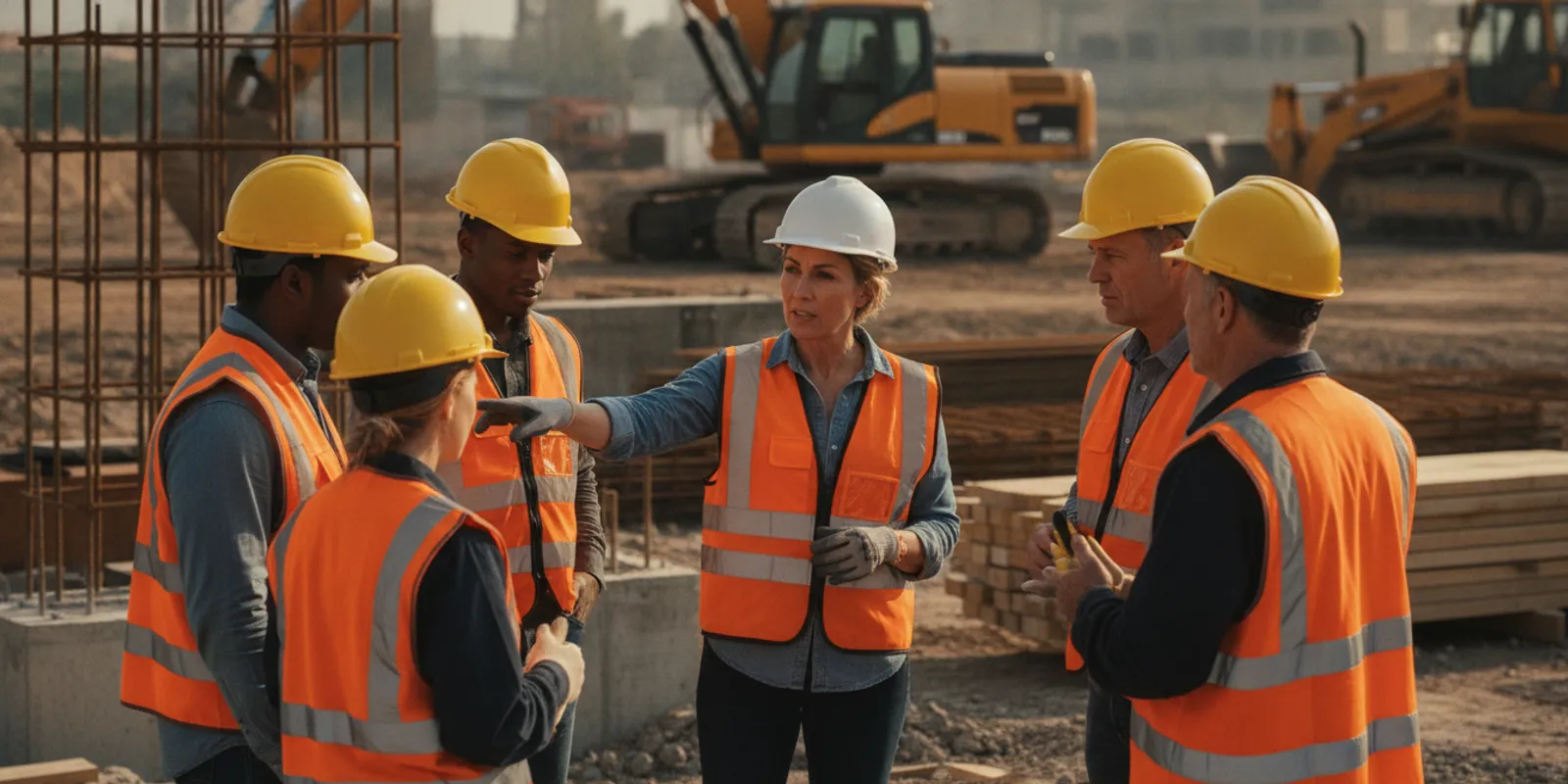
Construction safety training works best when it prepares each person for the tasks, equipment, and changing conditions they will actually encounter. A reliable program is not a one-time orientation or a stack of sign-in sheets. It is a repeatable process for identifying who needs what instruction, delivering it before exposure, checking whether workers understand it, and updating it when the work changes.
Talk with our team about workforce compliance
For construction employers, the challenge is coordination. Crews may move between projects, subcontractors may perform specialized work, and hazards can change as a site develops. Training must fit those realities while meeting applicable requirements for the work and jurisdiction. This guide offers a practical framework for building a role-based program, assigning responsibilities, and keeping evidence that training took place.
What should a construction safety training program accomplish?
A program should help workers recognize relevant hazards, understand the controls and procedures that apply to their tasks, know when to stop and ask for direction, and understand how to report a concern or incident. It should also make clear who is responsible for instruction, field oversight, and follow-up.
Training is one part of a broader safety system. It does not replace hazard assessments, safe equipment, effective supervision, or correction of unsafe conditions. Nor does a completed course automatically establish that an employee is ready for every assignment. Employers need to connect instruction to the actual job and verify that workers can apply it.
Research on construction safety and health goals notes that training can improve workers’ knowledge and skills, which may contribute to improved outcomes. A construction safety training study also considers differing expectations of managers and workers, underscoring why program design should account for both groups rather than treating training as a one-way presentation. See the CDC-hosted construction safety and health training research and the study of construction managers’ and workers’ training perspectives.
How should employers map training to job roles?
Start with the work, not a generic list of courses. Make an inventory of job roles, tasks, equipment, work areas, and conditions that may expose people to hazards. Include temporary workers, supervisors, subcontractor personnel, and people who visit or support the site when relevant. Then identify what each group must know before starting and what may require additional instruction.
A role matrix makes gaps visible. It can list each role, required orientation, task-specific topics, who provides training, how understanding is checked, and what evidence is retained. The matrix should point to applicable company procedures and regulatory requirements rather than attempting to replace them. Have a qualified person review requirements for the project, state, and type of work.
| Role or group | Training focus | When to provide or revisit | Useful evidence |
|---|---|---|---|
| New or returning worker | Site rules, emergency actions, reporting, access limits, and current worksite hazards | Before entering the work area; revisit after a significant site or assignment change | Orientation record and confirmation of site-specific understanding |
| Task crew | Hazards, controls, tools, procedures, and coordination for the assigned activity | Before the task begins and when conditions, methods, or equipment change | Task briefing, attendance, and field verification |
| Equipment operator | Equipment-specific hazards, operating procedures, inspection expectations, and communication | Before assignment and when equipment or work conditions change | Training and evaluation records appropriate to the equipment and rules |
| Supervisor or designated competent person | Hazard recognition, required inspections or evaluations, escalation, and corrective action | Before taking responsibility; refresh when duties or applicable requirements change | Role designation, qualifications where required, and inspection or action records |
| Subcontractor personnel | Site-specific hazards, shared controls, coordination, and reporting channels | Before work begins and during coordination as the project changes | Orientation and communication records linked to the crew or work package |
This matrix is a planning aid, not a substitute for determining which requirements apply. A job hazard analysis can help organize task hazards and controls, while the employer remains responsible for selecting appropriate training and oversight.
What belongs in new-worker orientation?
Orientation gives a worker the basic information needed to enter and function on a particular site. Cover emergency alarms and response, how to report injuries and hazards, access restrictions, required protective equipment, site traffic and pedestrian routes, housekeeping expectations, and how workers receive task instructions. Explain who the worker should contact when a condition is unclear or changes.
Make orientation specific to the project. A general company presentation cannot explain a site’s changing access points, nearby operations, current emergency arrangements, or the interaction between crews. Use maps, demonstrations, walk-throughs, or short scenarios where they help workers understand the environment. Provide language and communication support suited to the workforce, and allow time for questions.
Before work starts, ask workers to explain key actions in their own words or demonstrate a relevant procedure. A signature can document attendance, but it does not show by itself that a person understood the material. Record any follow-up instruction and resolve gaps before assigning work that depends on the skill or knowledge.
How do you choose hazard-specific training?
Use task planning and hazard assessments to decide what instruction is needed. For each work activity, ask what could cause harm, who may be exposed, what controls are required, and which employees need to recognize, apply, inspect, or oversee those controls. Include the steps where a worker must pause, obtain authorization, or coordinate with another crew.
Training should be concrete. For a tool or piece of equipment, use its relevant procedures and explain pre-use checks, operating limits, communication, and what to do when something is wrong. For work involving a changing environment, explain how workers will receive updates and who has authority to revise the plan. Use demonstrations or supervised practice for tasks that require physical skills; a lecture alone may not show whether a person can carry them out.
Separate awareness from task qualification. A worker may need to understand a hazard without being authorized to perform the associated work. Make those limits explicit. Supervisors should know how assignments are approved, what qualifications or evaluations are required, and where records can be verified. Review applicable federal, state, local, and project-specific requirements with qualified safety personnel; do not assume one course satisfies every obligation.
Employers can also connect topic planning to their wider industry and workforce compliance needs and consult the company’s compliance resources when developing supporting processes. Employers can use a written training plan to assign an owner for each topic, note where project-specific instruction is delivered, and set a review date. The plan should be easy for supervisors to use before assigning work, not only for administrators to audit later.
What are competent-person responsibilities?
Some construction duties require a competent person under applicable rules. Employers should identify which activities trigger that requirement, confirm the person meets the relevant definition and has the authority needed to take prompt corrective measures, and document the designation and scope of responsibility. The exact requirements vary by activity, so verify them against current rules rather than relying on a generic title or job description.
Training for supervisors and designated persons should match their actual duties. Depending on the assignment, that may include recognizing hazards, conducting required inspections or evaluations, communicating findings, stopping or changing work when needed, and tracking correction through completion. A person who attends a course but lacks authority, time, or access to act cannot effectively fulfill an oversight role.
Clarify the boundary between general worker training and specialized oversight. Workers need to know how to raise a concern and follow the safe work plan. The designated lead needs to know how to assess the concern, who to notify, and how to ensure the hazard is addressed. Keep the reporting route simple and make sure it works across shifts and employers.
How should subcontractors coordinate training?
Before a subcontractor starts, agree on who provides company-specific and site-specific instruction, what the general contractor communicates, and how task changes or new hazards are shared. Exchange the relevant work plans, emergency procedures, access rules, and coordination contacts. Confirm how crews will report incidents, near misses, and unsafe conditions, and how corrections will be relayed to affected employers.
Do not treat a subcontractor’s orientation record as proof that every site hazard has been covered. Check that the crew understands the current site rules and the interfaces between simultaneous operations. For example, one crew’s lifting or delivery plan may affect another crew’s access or work zone. Include coordination in pre-task discussions and update it when sequence, location, or conditions change.
Assign a named contact on each side for training questions and operational changes. Keep a record of the briefing or exchange, attendees, topics, and any open action items. If a worker changes employers, tasks, or work areas, check whether the existing instruction still applies instead of assuming that earlier orientation remains sufficient.
When should training be refreshed?
Set refreshers based on applicable requirements, the hazard, the task, and what field observations show. A calendar can help prevent required renewals from being missed, but calendar dates alone are not enough. Provide additional instruction when a worker moves to a different task, new equipment or methods are introduced, site conditions change, a procedure is revised, or observation shows that the worker is unsure or not following the expected steps.
Use incidents, near misses, inspection findings, and employee questions as signals to review training. The response should address the underlying cause. If workers were not told about a revised route, update the communication process. If a procedure was unclear, improve the instruction and the procedure. If a worker cannot demonstrate a task, provide coaching and reassess before relying on that skill.
Short, focused toolbox talks can reinforce a topic, but they should not be used to disguise a missing initial or required course. Record the subject, date, instructor, participating workers, and any follow-up. Repeat the instruction in a format workers can understand and use the opportunity to surface changing site conditions.
How can employers check whether training is working?
Use more than attendance. Ask a worker to explain the steps, demonstrate the relevant action, identify a hazard during a walk-through, or describe how to report a problem. Select a check that matches the learning objective. A short discussion may confirm understanding of an emergency contact, while equipment operation requires a more practical assessment consistent with applicable rules and company procedures.
Supervisors should observe work after training and provide timely feedback. Look for whether workers use the control, follow the sequence, communicate changes, and know when to stop. An observed gap does not automatically mean the worker was careless; it may point to unclear instruction, missing tools, conflicting production demands, language barriers, or a control that is impractical. Investigate and correct the system as well as addressing individual knowledge.
Review patterns periodically. Repeated questions or similar incidents may reveal a topic that needs redesign, better translation, more hands-on practice, or clearer supervision. Involve workers in identifying those improvements. A two-way process can expose differences between what management believes has been taught and what workers need to carry out the task safely.
What training records should the employer keep?
Build a record that lets a reviewer determine who received what instruction, when it occurred, who provided it, and how participation or understanding was checked. Depending on the course and rules, retain the training materials or outline, assessment results, relevant qualifications, and records of follow-up. Keep records organized by worker and topic, with a practical way to find current status before assignment.
- Worker name or other reliable identifier, employer, role, and work location.
- Training topic, date, duration where relevant, instructor, and delivery method.
- Applicable equipment, task, procedure, or site covered.
- Attendance and any evaluation, demonstration, or knowledge check.
- Refresher due dates where a rule or program requires them, plus completion evidence.
- Documented gaps, corrective instruction, and the person responsible for follow-up.
Limit access to records to people who need them, protect personal information, and follow applicable retention rules. Keep the program’s written procedures, training matrix, and revision history current as well. Patriot’s workforce compliance services provide one route for employers seeking support with broader compliance processes; requirements for construction safety instruction should still be reviewed against the employer’s specific work and regulations.
How do the main program elements fit together?
The elements reinforce one another. The hazard review determines what workers need to know. Role assignments identify who must receive it and who is responsible for delivery and oversight. Site coordination makes sure the instruction reflects shared work and changing conditions. Evaluation checks whether the lesson transferred to the job. Records make the process traceable and help identify what is due next.
Review the program when a project starts, when work changes, and at planned intervals. Ask whether the role matrix still matches actual assignments, whether subcontractors receive timely updates, whether records are easy to retrieve, and whether observed work aligns with the instruction. Close each review with an owner and a due date for any needed update, rather than leaving concerns as informal notes.
Frequently asked questions about construction safety training
Is a single orientation enough for a construction worker?
Usually, orientation covers general and site-specific information, not every hazard or skill associated with a worker’s tasks. Add the instruction required for the worker’s role, equipment, assignment, and applicable rules. Reassess when the work or site changes.
Can a toolbox talk replace required training?
Not automatically. A toolbox talk can reinforce a topic or communicate a change, but it should not be treated as a substitute for a course, qualification, or evaluation that applicable rules require. Verify the requirement and document what was delivered.
Who is responsible for subcontractor training?
Responsibilities depend on the work, contract, site arrangements, and applicable requirements. Employers should coordinate before work begins, identify who covers company and site information, share relevant hazards, and verify that each crew understands the rules and controls that apply.
How can an employer tell if training was effective?
Match the check to the task. Ask questions, observe a demonstration, or verify performance in the work area. Then follow up through supervision and review whether workers apply the control. Attendance records are useful, but they do not alone establish understanding.
Contact Patriot Safety and Services to discuss compliance support
A dependable construction safety training program is role-based, tied to current hazards, coordinated across employers, and reviewed against actual work. By assigning clear owners and checking understanding in the field, employers can make training a working part of site safety rather than a one-time paperwork exercise.