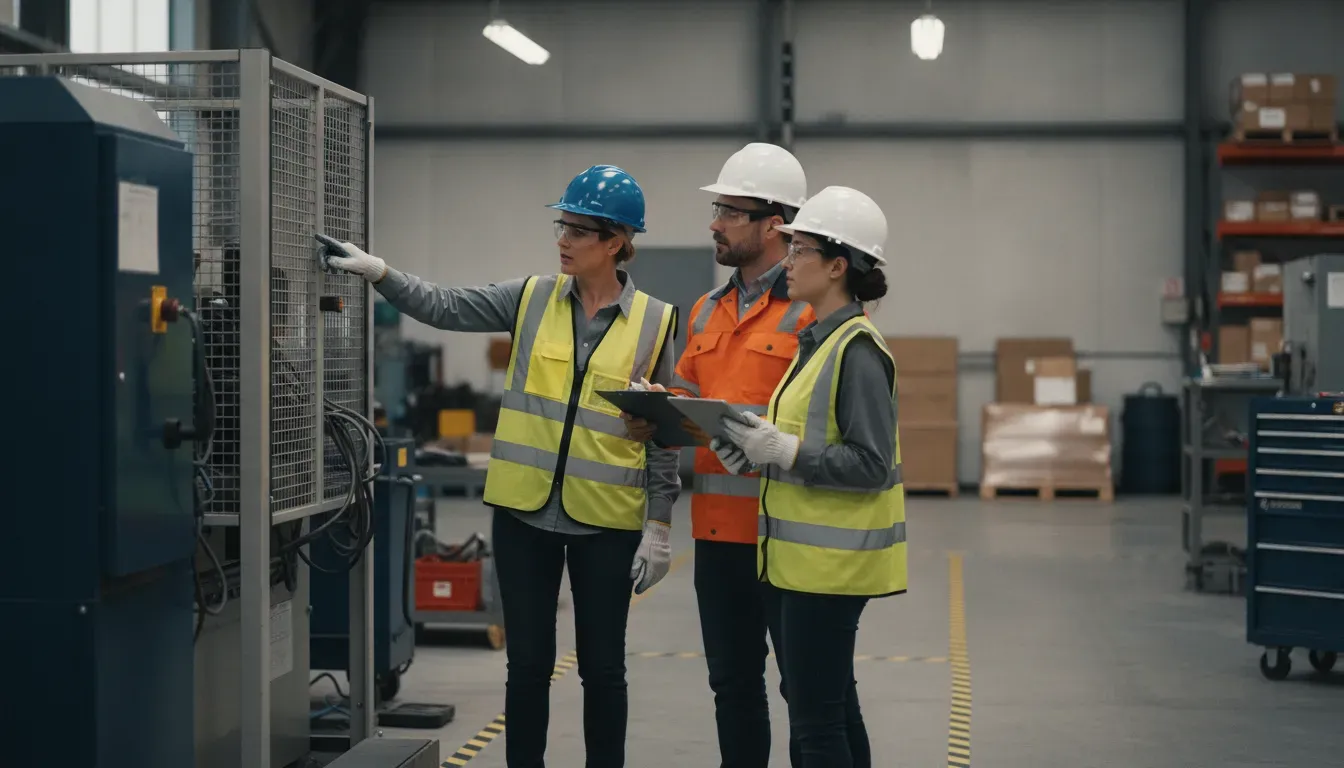
A workplace incident investigation procedure gives employers a consistent way to respond after an injury, illness, property-damage event, or near miss. The goal is not to find someone to blame. It is to preserve the facts, understand how work conditions and decisions combined, correct the underlying causes, and verify that the changes reduce the chance of recurrence.
Discuss your incident response and safety program with Patriot Safety and Services LLC
What is a workplace incident investigation procedure?
A workplace incident investigation procedure is a written process that moves from immediate response to evidence collection, root-cause analysis, corrective action, and follow-up. It should apply to events that cause harm and to close calls where a worker could have been harmed under slightly different circumstances.
The Occupational Safety and Health Administration encourages employers to investigate injuries, illnesses, and close calls. OSHA also recommends using the term incident rather than accident because an incident investigation is intended to identify preventable conditions, not treat the event as random or unavoidable. An investigation can support a safety and health program, but it does not replace emergency care, required notifications, recordkeeping, workers' compensation processes, or legal advice.
Write the procedure before an incident occurs. Identify who may activate it, who leads the investigation, how the scene is secured, which records are collected, and how corrective actions are tracked. The process should be understandable to supervisors and employees who may need to use it during a stressful event.
1. Prepare the investigation process before an incident
Preparation makes the first response faster and helps prevent the loss of evidence, inconsistent interviews, and unclear ownership. Employers should establish the process as part of the broader safety management system, not create it after a serious event.
Define the types of events that require review. Include injuries and illnesses, property damage, equipment failures, releases, vehicle events, fires, security or violence-related events when appropriate, and near misses. The level of review can vary with the potential severity and complexity, but a low-consequence event should not be dismissed if it reveals a serious hazard.
Assign roles in advance. A supervisor may secure the area and begin the initial report, while a safety professional or manager leads the fact-finding. Include employees who understand the work, equipment, and normal conditions. For complex incidents, consider maintenance, engineering, human resources, environmental health and safety, or other subject-matter support. Keep the investigation focused on learning and hazard control, while referring legal, medical, insurance, or employee-relations questions to the appropriate qualified professionals.
Prepare a basic investigation kit and a secure record location. Depending on the work, the kit may include a camera, measuring tools, tags or barriers, a flashlight, blank paper, a sketch template, interview prompts, and personal protective equipment. Confirm that using a camera or recording interviews follows company policy and applicable privacy requirements.
2. Respond to the event and make the area safe
The first priority is life safety and emergency response, followed by controlling hazards that could injure additional people. Investigation activities must never delay medical care, emergency services, evacuation, rescue, or other actions needed to protect workers and the public.
Use the site emergency plan and notify the designated leaders. Provide first aid or summon emergency medical services as appropriate. Control ongoing energy, releases, traffic, fire, electrical, chemical, structural, or other hazards only when responders are trained and authorized to do so. Account for affected employees and keep untrained people away from the area.
Once the immediate danger is controlled, restrict access to the affected area as appropriate. Use cones, tape, guards, shutdowns, or other controls to prevent evidence from being moved or conditions from changing unnecessarily. Coordinate with emergency responders and do not interfere with their work. Make a note of what had to be changed for rescue, hazard control, or medical care because those changes are part of the incident record.
Keep required reporting and recordkeeping decisions separate from the fact-finding workflow. Requirements may depend on the event, industry, location, and governing agency. If the event may trigger a notification, preserve the relevant facts and involve the person responsible for regulatory reporting promptly.
3. Preserve and document the incident scene
Preserve the scene as soon as it is safe, then document conditions before cleanup, repair, or normal work changes what investigators can observe. The record should describe what was present, not what investigators assume happened.
Record the date, time, location, work activity, people involved, injury or damage description, weather or lighting conditions when relevant, and the names and roles of investigators. Photograph the general area first, then take closer views of equipment, tools, controls, surfaces, access points, warning signs, personal protective equipment, and other relevant details. Take images from more than one angle and include scale when size or distance matters.
Create a simple sketch when the relationship between people, equipment, materials, or boundaries is important. Mark fixed reference points and note approximate distances. Preserve relevant objects, components, samples, electronic records, and documents in a controlled way when they may help explain the event. Label what was collected, by whom, when, and where it was stored. Do not alter equipment or discard material unless needed to protect people or prevent further damage, and document any necessary change.
Collect the work instructions, permits, job hazard analyses, inspection records, maintenance history, training records, shift information, staffing information, and relevant communication. The records should be limited to what helps explain the work and conditions. Protect personal and confidential information and share it only with people who need it for the investigation or required response.
4. Collect information and interview people promptly
Use a fact-finding approach that lets people describe what they saw, heard, did, and understood without being coached toward a preferred explanation. Interviews are most useful when the scene is secure and people can remember the details.
Speak with the injured or affected person, witnesses, supervisors, people who performed similar work, and specialists who understand the equipment or process. Interview people separately when practical so one account does not shape another. Choose a setting that is private, respectful, and appropriate for the employee. Use the employee's language or a qualified interpreter when needed. Explain that the purpose is to learn how to prevent a recurrence, not to search for someone to punish.
Start with open questions. Ask the person to describe the task from the beginning, what changed, what they expected, what they observed, and what happened next. Follow up with specific questions about location, timing, equipment status, instructions, communication, workload, staffing, supervision, and environmental conditions. Ask what would have prevented the event and whether the same condition exists elsewhere.
Do not interrupt unnecessarily or fill gaps with assumptions. Take clear notes and distinguish a direct observation from an interpretation. If recording is permitted, obtain the required permission before recording. Review factual statements for accuracy, clarify inconsistencies without arguing, and document when information is uncertain. It is acceptable for accounts to differ. The investigation should compare each account with physical evidence, records, and the sequence of work rather than select the first explanation that sounds plausible.
Use a timeline to organize the information. Include what happened before the event, the initiating event, the immediate response, and changes after the event. A timeline helps investigators see contributing conditions that may not be obvious when attention is focused only on the injury or damage.
5. Determine immediate, contributing, and root causes
Root-cause analysis asks why the conditions existed and why the safety system did not identify or control them earlier. A conclusion that an employee was careless or failed to follow a rule is not a complete investigation.
Separate the levels of cause. An immediate cause is the unsafe condition or action closest in time to the event. Contributing factors are conditions that made the event more likely, such as equipment condition, unclear instructions, an unplanned change, communication gaps, workload, staffing, supervision, or environmental conditions. Root causes are underlying weaknesses in design, planning, procedures, training, maintenance, management, or the safety and health program that allowed the contributing factors to remain.
Ask why repeatedly, but do not use the question as a mechanical count. For example, if a guard was missing, ask why it was removed, why the work continued, whether the removal was authorized, whether the guard was easy to reinstall, whether inspections identified the condition, and whether production or maintenance planning influenced the decision. Then ask why the management system did not resolve those conditions earlier.
Compare the written procedure with the way the job was actually performed. A difference may indicate a training issue, but it may also show that the procedure was impractical, the tools were unavailable, the process changed, or the instruction did not reflect the real task. Evaluate equipment, procedures, training, work environment, supervision, and management decisions together.
Use the OSHA incident investigation overview and its Incident Investigations: A Guide for Employers as reference points for a systems-based review. OSHA describes its guide as advisory information, so employers should also identify the rules and professional requirements that apply to their specific operations.
Need help organizing a corrective action review? Talk with Patriot Safety and Services LLC.
6. Select corrective actions that address the causes
Corrective actions should change the conditions that allowed the event, with a responsible owner, due date, resources, and a method for verifying effectiveness. A reminder to be more careful is rarely enough when the investigation finds a design, equipment, planning, or process weakness.
Start with the strongest practical control. Consider whether the hazard can be eliminated, whether a safer material or process can be substituted, and whether an engineering control can separate people from the hazard. Administrative controls, procedures, scheduling, staffing, supervision, and training may support the response. Personal protective equipment can be important, but it should not be the only action when a stronger feasible control is available.
Make each action specific. Instead of writing "improve housekeeping," identify the area, the condition to correct, the person responsible, the completion date, and how a supervisor will verify the result. Instead of "retrain employees," specify the task, the procedure to review, the employees who need instruction, the practical demonstration or check, and the condition that caused training to be needed.
Look for similar exposure elsewhere. A corrective action for one machine may need to apply to other machines, shifts, facilities, contractors, or work teams. Update related procedures, job hazard analyses, inspection criteria, preventive maintenance, training, and emergency plans when the investigation shows that those tools need revision. Employers building the wider system can also review Patriot's workplace safety program development guide for planning, training, inspection, incident learning, and program review considerations.
7. Document findings and communicate the lessons
An investigation record should show the evidence reviewed, the causes identified, the actions assigned, and the decisions made about follow-up. It should be clear enough for another qualified person to understand the reasoning without turning the report into a blame statement.
Include a concise event summary, scope of the investigation, timeline, scene documentation, witness and document sources, analysis of immediate and root causes, corrective action plan, owners and dates, and any open questions. Record facts and uncertainty separately. If the team could not determine an issue, state what information was unavailable and what will be done to resolve it.
Share relevant lessons with the people who perform similar work. Explain what changed, why it changed, and how workers can raise concerns if the control does not work. Do not disclose unnecessary medical or personal information. The message should reinforce reporting and participation, not make employees afraid that reporting a near miss will result in punishment.
A broader emergency plan may need revision after an event. For operations with remote or high-risk work, review the emergency response plan guide for oil and gas sites as an example of how response responsibilities and communication should be planned around the work. Keep the new procedure connected to the actual hazards and response resources at each location.
8. Follow up and verify that controls work
The investigation is not complete when the report is signed; it is complete when assigned actions are implemented and checked in the work environment. Close each action only after the responsible owner provides evidence that the change is in place and functioning as intended.
Set follow-up dates based on the risk and complexity. A simple action may be checked during the next shift or inspection. A process or engineering change may need observation over time, worker feedback, maintenance review, or a repeat hazard assessment. Ask whether the new control is being used, whether it creates a new risk, and whether the original exposure still exists on another shift or site.
Track overdue actions and escalate barriers. If an action cannot be completed by the original date, document the reason, interim protection, revised owner, and revised date. Senior leaders should review serious or recurring findings because resources and operational priorities may be part of the root cause.
Use trends carefully. More near-miss reports can indicate that employees trust the reporting process more, not that conditions have necessarily become worse. Review the quality of reports, recurring causes, time to close actions, repeat events, and employee feedback together. Avoid targets that discourage reporting or encourage people to hide small events.
Incident investigation checklist for employers
Use this checklist to make the procedure repeatable while adapting the level of review to the event's potential severity and complexity. It is a planning aid, not a substitute for requirements that apply to a specific industry, state, or incident.
| Stage | Key questions | Record or output |
|---|---|---|
| Immediate response | Are people safe, receiving care, and protected from continuing hazards? | Emergency response, notifications, and safety controls |
| Scene preservation | What must be secured, photographed, measured, sketched, or preserved? | Photos, sketch, scene notes, evidence log |
| Information collection | Who saw or performed the work, and which records explain the conditions? | Interviews, timeline, procedures, permits, training and maintenance records |
| Cause analysis | What immediate, contributing, and system-level factors allowed the event? | Cause analysis with facts, uncertainty, and supporting evidence |
| Corrective action | Which controls address the causes, and who owns each action? | Action plan with owner, date, resources, and verification method |
| Follow-up | Did the control work in practice, and does the same exposure exist elsewhere? | Effectiveness check, closure evidence, and program updates |
How should employers investigate near misses without assigning blame?
Investigate a near miss with the same learning mindset used for an injury: understand the conditions, protect employees, and correct the hazard before the outcome is more severe. A near miss may reveal a weak barrier even when no one was hurt.
Use neutral language in the report. Describe the task, conditions, sequence, and controls that failed or were missing. Avoid labels such as careless, reckless, or lucky when a more precise description is available. Ask what made the action or condition reasonable at the time, what information the worker had, and what system changes would make the safer choice easier.
Thank employees for reporting and close the loop. Tell them what the investigation found and what will change. If the review results only in a warning to pay attention, test whether a stronger control was considered. A respectful process helps employers learn from small events and makes it more likely that workers will report hazards before someone is injured.
How is an investigation different from a legal fault determination?
A safety investigation explains how an event occurred and what controls can prevent recurrence; it does not by itself decide legal liability, workers' compensation eligibility, discipline, or regulatory responsibility. Those decisions may involve different processes, evidence standards, confidentiality requirements, and qualified professionals.
Keep the safety investigation focused on hazard prevention. Coordinate with human resources, legal counsel, insurers, medical professionals, and regulators when their responsibilities apply. Do not promise employees that a report is privileged or confidential unless the appropriate professional has established that protection. This separation allows the organization to learn from the event while handling other obligations through the correct channels.
For employers that need help connecting incident learning with a broader compliance program, Patriot Safety and Services LLC provides safety, compliance, and workforce support for regulated and high-risk operations. Review the services hub to identify the support that fits your operation.
Talk with Patriot Safety and Services LLC about your workplace incident investigation procedure
Frequently asked questions
Should employers investigate near misses?
Yes. OSHA encourages employers to investigate close calls because they can reveal hazards and weak controls before a worker is injured. The depth of the review should match the potential severity and complexity of the event.
Who should lead a workplace incident investigation?
A supervisor may begin the response, but the investigation should include people with knowledge of the work and the relevant safety, equipment, or management systems. For complex events, add qualified subject-matter support. The team should be able to examine conditions without treating the review as a search for blame.
What records should be collected after an incident?
Collect records that help explain the work and conditions, such as procedures, permits, job hazard analyses, inspection and maintenance records, training records, shift information, relevant communications, scene photographs, sketches, and interview notes. Protect personal and confidential information and involve the appropriate professionals when required.
What makes a corrective action effective?
An effective corrective action addresses an identified cause, has a responsible owner and due date, includes the resources needed to complete it, and is checked in the workplace. Actions should be evaluated for similar exposures at other locations, shifts, or work teams.
When is an incident investigation complete?
The investigation is complete when the facts and causes have been documented, corrective actions have been assigned and implemented, and the organization has verified that the controls work. If an action remains open, document the interim protection, owner, barrier, and follow-up date.
A consistent workplace incident investigation procedure helps employers respond with care, learn from what happened, and improve the systems that shape daily work. The strongest process protects people first, preserves reliable information, looks beyond individual blame, and follows corrective actions until the workplace reflects the lessons learned.