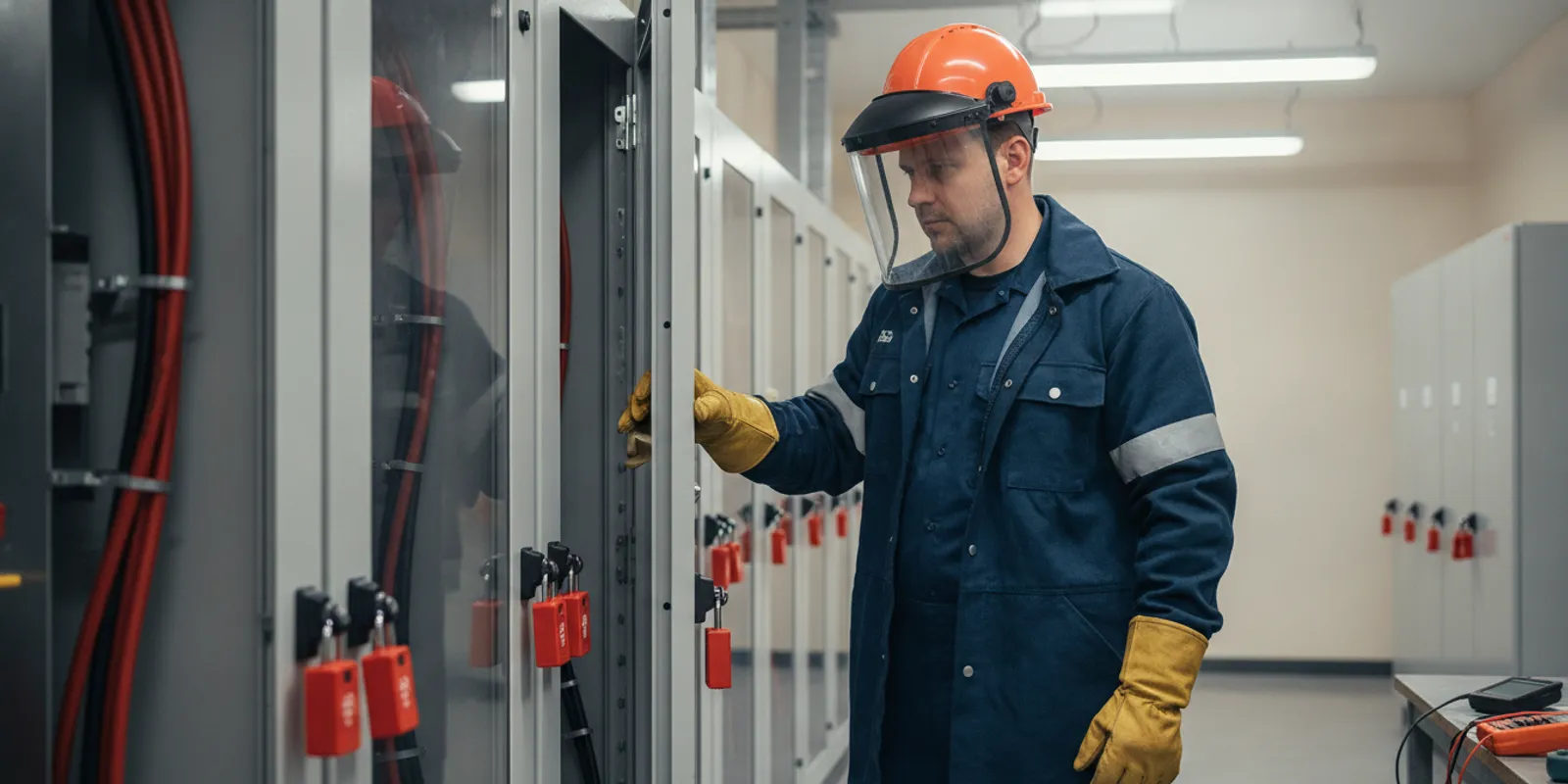
High voltage safety training should prepare workers to recognize electrical hazards, avoid exposure, and follow controlled work procedures, not simply memorize terminology. Employers need to match training to each worker’s tasks, equipment, and level of access. This guide explains how to build a practical program while distinguishing specialized high-voltage preparation from general electrical safety awareness.
Talk with our team about workforce safety support
What should high voltage safety training cover?
High-voltage work can involve electric shock, arc flash, arc blast, burns, fire, and secondary injuries from falls or involuntary movement. Voltage is only one part of the risk. Available fault current, protective-device clearing time, equipment condition, work distance, and the task itself also matter. Training should explain these hazards in terms workers can apply at the site, not leave them with a list of unfamiliar terms.
Begin with a task inventory. Include routine operation, inspection, troubleshooting, maintenance, switching, testing, and emergency response. Consider nonroutine work such as a contractor entering a substation, a mechanic removing a panel, or a worker helping move material near electrical equipment. The goal is to identify where people could encounter exposed energized parts, stored energy, or a changed work condition.
- Recognize warning labels, restricted areas, exposed conductors, and damaged equipment.
- Understand authorization limits, stop-work authority, and who approves a task.
- Choose a safe work plan, including de-energizing when feasible.
- Use barriers, insulating equipment, test instruments, and PPE as directed.
- Communicate changes, hazards, near misses, and equipment defects.
- Respond to an incident without exposing a rescuer to the same hazard.
Use demonstrations and scenarios, not just classroom explanation. For instance, show a label and ask a worker what information they need before approaching the equipment. Have the worker explain which supervisor to notify and what to do if the label is missing or unreadable. A sign-in sheet records attendance; it does not show that someone can apply a procedure.
Who is a qualified person?
“Qualified person” is not a title to assign casually. Electrical qualification depends on training and demonstrated ability to recognize and avoid hazards associated with particular equipment and work. Someone may be qualified for a specific task or voltage range but not for another. Employers should document the work authorized and its limits, and make sure job assignments stay inside those limits.
Workers who are not qualified still need appropriate hazard-awareness instruction. They should know how to maintain required distance, obey signs and barriers, avoid opening enclosures, and report unsafe conditions. General orientation does not authorize someone to perform electrical tasks. Supervisors need to recognize when a task requires a qualified worker, a permit or hazard review under the site program, or a pause until the right expertise is available.
Training should make clear how authorization works in practice. A worker asked to perform a task outside their documented scope should know to stop, explain the mismatch, and contact the supervisor. A supervisor should not treat a worker’s experience with similar equipment as proof of qualification for a different installation. For regulated workplaces, consult competent electrical and safety professionals when interpreting applicable requirements.
Columbia’s electrical safety guidance describes topics including basic electrical safety, high-voltage electricity, and specialized equipment. Use authoritative guidance as a supplement, not a substitute for site-specific instruction.
How should employers control electrical hazards?
The work plan should first ask whether the task can be completed with the equipment de-energized. Where feasible, identify and isolate every relevant energy source, apply the employer’s lockout/tagout process, and verify absence of voltage with an appropriately rated instrument. Follow the approved procedure, including proving the test instrument before and after use when required. Workers should understand that operating a switch or seeing an indicator go dark is not, by itself, verification that the hazard is controlled.
Before work begins, the person leading it should identify the equipment, sources, isolation points, affected systems, and people who may be exposed. Consider backfeed, stored energy, alternate supplies, and the possibility that another crew could restore power. Communicate the boundary of the work and the status of isolation to affected workers. If conditions differ from the plan, stop and reassess rather than improvising.
If work must proceed energized, require an appropriate documented justification and a task-specific plan under the employer’s program and applicable rules. Identify the task, hazards, authorized workers, protective measures, boundaries, tools, PPE, communications, and emergency arrangements. Energized work should not become the default because shutdown is inconvenient. A plan should also specify stop-work triggers, such as an unexpected condition, unclear equipment identification, or missing protective equipment.
| Control | Purpose | Employer action |
|---|---|---|
| De-energize and isolate | Remove the electrical hazard where practicable | Define isolation points, lockout/tagout steps, and verification |
| Engineering and physical barriers | Prevent access or contact | Maintain covers, interlocks, guards, barricades, and warning signs |
| Safe work procedure | Control exposure when hazards remain | Specify sequence, roles, boundaries, communication, and stop criteria |
| PPE and insulated tools | Reduce risk from remaining hazards | Select for assessed exposure and inspect before use |
| Training and authorization | Support safe, competent execution | Verify skills, scope, and refresher needs for assigned work |
Controls work as a system. PPE does not make an avoidable energized task acceptable, and a procedure is ineffective if workers lack equipment or authority to stop. Consider a maintenance team scheduled to inspect a panel. The lead should confirm the panel identity, review its condition and labels, identify isolation options, assign authorized roles, and confirm tools and protective equipment before anyone opens it. If the drawing does not match the installation, the job pauses until the mismatch is resolved.
How do approach boundaries work?
Approach boundaries establish limits around exposed energized conductors or circuit parts. They help determine who may enter an area and what precautions are required. Distances depend on factors such as voltage and the applicable electrical safety standard. Do not copy a generic distance from a poster or assume one boundary applies to every installation.
Before work, identify exposed energized parts and determine applicable boundaries using current requirements and site procedures. Mark or barricade the area when needed. Control access, position tools and materials so they cannot cross a boundary unintentionally, and assign a safety observer when the plan requires one. Make the boundary visible to other crews, delivery personnel, and supervisors who may enter the area.
Training should use the employer’s actual labels, drawings, and work examples. Ask workers to explain what changes when an enclosure is opened, when a cover is removed, or when a person must enter a restricted area. They should know when to stop and request an authorized person rather than estimate a safe distance. A useful practice scenario is a worker moving a ladder or long tool through a work zone: the worker should identify the hazard, choose a route, and confirm whether the proposed movement can remain outside controlled limits.
How should PPE be selected and maintained?
Select PPE based on the hazard assessment and task, not on an assumption that heavier gear is always safer. Depending on exposure, protection may include voltage-rated gloves with protectors, arc-rated clothing, face and head protection, eye protection, hearing protection, and dielectric footwear. Use equipment rated and configured for the expected hazard, and follow manufacturer instructions and applicable standards.
Teach workers how to inspect PPE before use and recognize defects such as cuts, contamination, moisture, damaged seams, expired testing status, or compromised face shields. Insulating gloves require the inspection, testing, storage, and care specified by the employer’s program. Remove damaged equipment from service; do not improvise repairs or keep questionable items in the ready-to-use supply.
Fit and compatibility matter. A face shield that restricts visibility, clothing that leaves skin exposed, or gloves that interfere with handling can undermine safe work. Confirm that PPE is accessible at the job location and that workers know which items are required for each task. Where multiple layers are used, verify that they work together and do not obstruct communication or movement.
Build inspection into the work sequence. Before a task, workers can check the assigned equipment, confirm that it is suitable for the planned exposure, and report missing or damaged items. Supervisors should make replacement and testing responsibilities clear. After use, store equipment as instructed so it remains serviceable for the next task. Documentation should record inspections and required testing in the manner established by the program.
How can training prepare workers for emergencies?
Emergency planning must account for the possibility that a person is still in contact with an energized source. Workers should avoid direct contact until the hazard is controlled, raise the alarm, and follow the site rescue plan. Only people trained and equipped for the specific rescue should attempt it. Make clear that the impulse to help must not create another casualty.
Include how to summon help, who can isolate power, where communications equipment is located, and how responders can reach the work area. Explain who meets responders and provides information about the equipment and incident. Site plans should cover medical response and possible fire or arc-related injury, and should address conditions where access routes or communications may be impaired.
Practice realistic scenarios where appropriate. A short drill can reveal an unclear contact list, inaccessible shutoff, blocked route, or confusion over who can stop operations. For example, ask a team to walk through a simulated incident in which a worker is down near equipment. Participants should state their first actions, identify what they must not do, and explain how they will communicate with the designated responder. Correct gaps and share lessons with affected teams.
After a real event or near miss, preserve relevant information and review the response. Ask whether workers recognized the hazard, whether the emergency plan was available, and whether the roles were understood. Update procedures and training when the review identifies a weakness. Do not treat a drill as complete simply because the scenario ended; assign owners and follow up on corrective actions.
How should employers document and refresh training?
Maintain records that connect workers to the instruction and authorization required for assigned tasks. A useful record includes the date, topics, instructor or evaluator, worker participation, assessment method, practical demonstration where relevant, and restrictions or follow-up actions. Keep records accessible to supervisors responsible for work assignments.
Organize the training matrix around actual tasks and exposure. For each role, list required awareness instruction, specialized instruction, practical demonstrations, and authorization limits. For example, a worker who enters an electrical room only to perform unrelated duties may need hazard recognition and access rules. A worker who tests equipment needs task-specific training and demonstrated competence within the approved scope. Record differences rather than marking the entire workforce as having completed one generic course.
Refresh instruction when duties change, new equipment or procedures are introduced, observed practice shows a knowledge gap, or an incident or near miss reveals a weakness. Review the program periodically against applicable requirements and operational changes. Do not rely on a calendar alone if a meaningful change calls for retraining sooner.
A practical review cycle is: identify hazards and tasks, set learning objectives, deliver instruction and practice, verify competence, record results, and correct deficiencies. Then observe field work to see whether procedures are followed. If workers cannot explain a boundary or demonstrate the isolation process, improve instruction or supervision before assigning similar work again.
How can you distinguish high-voltage training from general electrical safety?
General electrical safety helps a broad workforce recognize hazards such as damaged cords, overloaded outlets, and unsafe equipment. High voltage safety training addresses specialized risks and controls for particular systems and tasks. It can include equipment-specific procedures, qualification limits, exposure boundaries, specialized PPE, and emergency response.
The two forms of instruction support one another, but neither automatically replaces the other. A worker may need general awareness without authorization to work on electrical systems. A qualified electrical worker still needs site orientation and task-specific preparation. Employers should map roles to training rather than treat a single course as a universal credential.
Consider a facility with a maintenance electrician, a contractor, and an administrative employee who occasionally walks through an electrical room. The electrician may need training and authorization for defined electrical tasks. The contractor needs orientation to site hazards, boundaries, and coordination rules as well as qualifications appropriate to the work. The administrative employee needs access restrictions and instructions on what to do if a door is open or an alarm is active. A single identical course would not address these different responsibilities equally well.
Employers seeking broader support can review workforce compliance services, explore occupational health services, and consult Patriot’s compliance resources. You can also learn about industries served and Patriot’s approach.
Discuss your workforce safety needs
Frequently asked questions
Does every employee need high voltage safety training?
No. Training should reflect exposure, duties, access, and applicable requirements. Workers who do not perform electrical work still need instruction on recognizing hazards and respecting boundaries in areas they may enter.
Can PPE replace de-energizing equipment?
No. PPE is one layer of protection for hazards that remain after other controls are considered. Employers should evaluate whether equipment can be de-energized and follow approved isolation and verification procedures.
How often should training be repeated?
Follow applicable rules and the employer’s program. Provide additional training when job duties, equipment, procedures, or worker performance indicate a need, and verify that workers can apply the controls.
What is the first step in planning a training program?
Assess equipment, tasks, and worker roles. Use that assessment to identify hazards, qualification needs, learning objectives, practical demonstrations, and records needed to support safe work.
High voltage safety training is effective when it is tied to real tasks, reinforced by workable controls, and verified through demonstrated understanding. Review the program when work conditions change and give workers clear authority to pause when a hazard is not controlled.