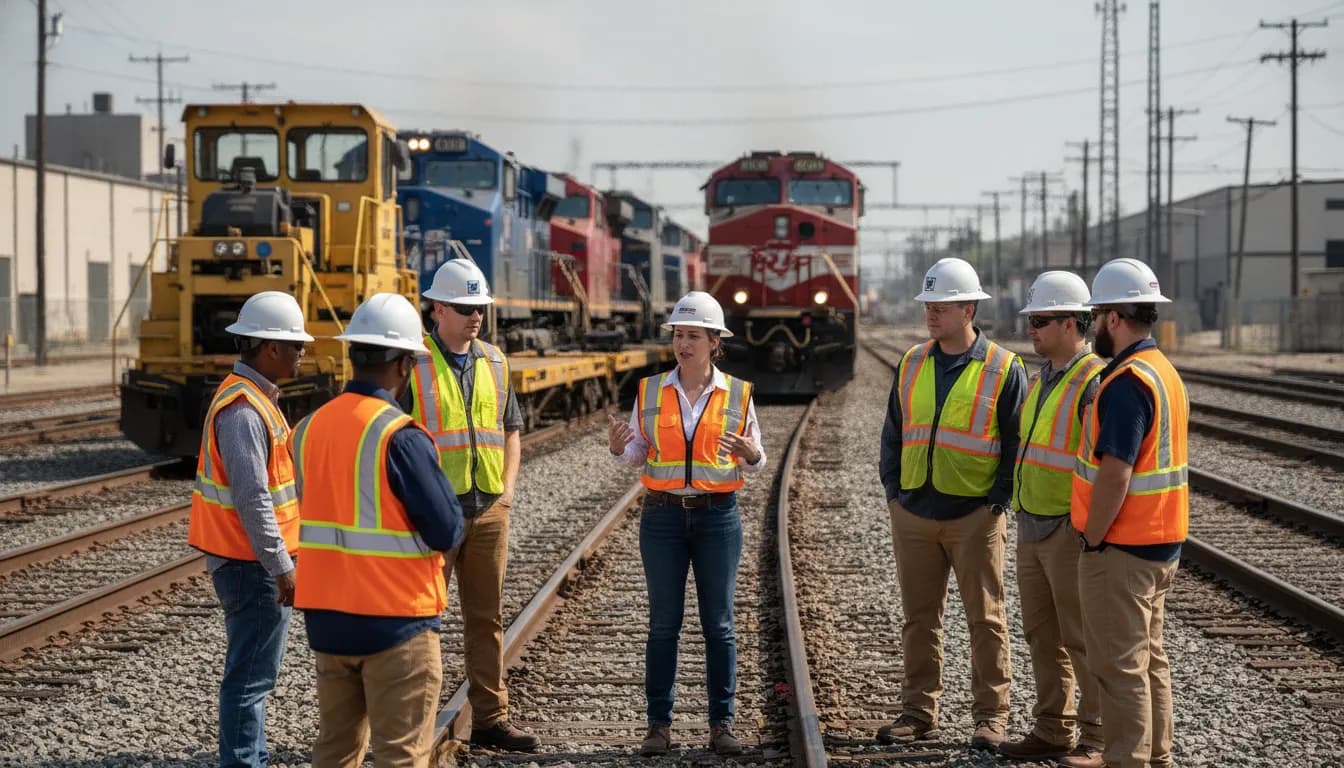
Railroad work rarely fits a single safety script. A track employee, contractor supervisor, equipment operator, and lone worker may face different hazards, follow different railroad procedures, and need different evidence of qualification. A practical program starts by defining those differences instead of treating attendance at a general safety meeting as proof that people can work safely.
Discuss your workforce compliance plan with Patriot Safety and Services.
A railroad safety training program should connect each role to the hazards, railroad rules, territory, hands-on expectations, and documentation that apply to its work. For example, 49 CFR 214.353 ties roadway-worker-in-charge qualification to working limits, train-approach warnings, territory characteristics, and demonstrated proficiency: see the eCFR requirements.
That scope-first approach gives employers and contractors a clearer way to build training, evaluate readiness, and coordinate responsibilities across a shared worksite. It also helps separate railroad operational instruction from related compliance activities such as testing and record administration.
Why a Railroad Safety Training Program Needs Clear Scope
A railroad safety training program should define who is being trained, where the work occurs, and which hazards the worker may encounter. It should also remain separate from FRA drug and alcohol testing, which addresses a different compliance function.
Clear scope prevents employers from treating a general safety orientation as proof of qualification for a specific railroad role. The Federal Railroad Administration identifies six safety disciplines, including grade crossings, hazardous materials, motive power and equipment, operating practices, signal and train control, and track. Those categories can help an employer build a hazard map, but they do not create one universal course for every worker or worksite. See the FRA railroad safety overview for the agency's current discipline structure.
Start by separating roles. A worker-in-charge may need training on the on-track qualifications of the workers being supervised, good-faith challenge procedures, working limits, train-approach warning rules, and territory characteristics. Those requirements are described in 49 CFR 214.353. The applicable content depends on the railroad, territory, duties, and operating procedures. A contractor should confirm requirements with the host railroad before assigning work.
Scope should also distinguish operational instruction from testing administration. Roadway-worker qualification, hazard controls, and emergency procedures belong in the operational safety plan. FRA drug and alcohol testing involves separate regulatory requirements, records, and program administration. Patriot Safety and Services supports workforce compliance and FRA-related testing administration, but this article does not represent that Patriot provides railroad roadway-worker or operational safety instruction. Keeping those functions distinct makes training records easier to defend and helps leaders identify which requirement each process is designed to satisfy.
How to Build a Railroad Safety Training Program
Answer: Build the program around each worker's role, territory, governing rules, hazards, demonstrated proficiency, and retrievable records. The right sequence turns broad safety expectations into job-specific preparation that can be verified.
- Map roles, work areas, and responsibilities. List the people who establish on-track safety, supervise or protect roadway workers, operate as lookouts, work alone, operate equipment, or coordinate contractors. Define the territory and physical conditions in which each person works. For a worker in charge, the applicable training includes the qualifications required of the workers being supervised and protected, along with relevant territory characteristics. Review the role against the current railroad and employer requirements, rather than assuming one curriculum fits every assignment.
- Identify governing rules and site hazards. Gather the operating railroad's procedures for working limits, train-approach warnings, communication, and good-faith challenges. Then inventory hazards by task and location, including moving equipment, visibility limitations, crossings, energized systems, and emergency conditions. Where equipment servicing is part of the work, connect the program to equipment hazardous-energy training and the employer's applicable energy-control procedures.
- Create instruction and realistic practice. Combine concise rule instruction with demonstrations, job briefings, scenario practice, and supervised field application. Practice should reflect the territory, equipment, communications, warning procedures, and decision points workers will encounter. Make clear which requirements come from the railroad, the employer's policy, or an applicable regulation.
- Assess demonstrated proficiency. Use observation, questions, simulations, or task demonstrations that match the person's assigned role. Do not treat attendance alone as qualification. For roadway workers in charge, the applicable rule states that initial and periodic qualification is evidenced by demonstrated proficiency, so retain the assessment basis and any corrective coaching.
- Control records and review triggers. Maintain a current record for each worker showing role, territory, training content, instructor or evaluator, assessment result, authorization, and corrective actions. Set a review process for role changes, territory changes, rule updates, incidents, or identified proficiency gaps. Keep records accessible to the people responsible for assigning work and verifying readiness.
What Should Role-Based Training Cover?
Short answer: A railroad safety training program should match instruction to each worker's authority, duties, territory, and railroad procedures. Qualification should be demonstrated through proficiency, not attendance alone.
The same safety briefing cannot prepare every person who works near active track. Under the cited Federal Railroad Administration roadway-worker rules, worker-in-charge, watchman/lookout, lone worker, and flagman roles have different responsibilities. Employers should also confirm the applicable railroad's rules, territory requirements, and authorization process before assigning work.
| Role | Training should address | Qualification focus |
|---|---|---|
| Worker-in-charge | On-track qualifications for the workers being supervised, good-faith challenge procedures, working-limit rules, train-approach warning rules, and the physical characteristics of the territory. | Remain immediately accessible and available to protected workers. Qualification is evidenced by demonstrated proficiency. See 49 CFR 214.353. |
| Watchman/lookout | Detecting and recognizing approaching trains, warning roadway workers effectively, determining the visibility distance needed for prescribed warning time, and following railroad warning procedures. | Initial and periodic qualification must be supported by demonstrated proficiency. See 49 CFR 214.349. |
| Lone worker | Train detection, prompt movement to a safe place, visibility distance, individual train-detection rules, working limits, definite train location, territory-specific on-track procedures, and access to the railroad's safety manual information. | The employer trains and qualifies the worker, while the operating railroad must authorize the worker to establish on-track safety on its tracks. See 49 CFR 214.347. |
| Flagman | Railroad operating rules for giving proper stop signals to trains and holding trains clear of working limits. | Qualification is evidenced by demonstrated proficiency. See 49 CFR 214.351. |
Employers can apply this framework by assigning each worker a defined role before the job briefing. Then map the role to the host railroad's procedures and the actual territory. The training record should identify the role, applicable rules, assessment method, and evidence of proficiency. If a worker changes duties, works in a different territory, or receives new instructions from the operating railroad, reassess whether the existing qualification still matches the assignment.
Roadway, Equipment, and Emergency Hazards
Answer: Organize hazard training by the work environment and the decisions workers must make there. Identify the exposure, apply the railroad's procedure, communicate changes, and respond correctly when conditions deteriorate.
A practical hazard matrix can follow the six disciplines identified by the Federal Railroad Administration: grade crossings, hazardous materials, motive power and equipment, operating practices, signal and train control, and track. This structure gives safety leaders a consistent way to map each worker's duties to the hazards they may encounter, while leaving room for railroad-specific rules and territory conditions. FRA's railroad safety overview provides the source taxonomy.
Build modules around real work
Track and roadway modules should address access, walking and working surfaces, train movements, working limits, visibility, and communication. Crossing modules can focus on vehicle and pedestrian exposure, warning devices, and the procedures that apply at each location. Equipment modules should cover locomotives, railcars, tools, stored energy, inspection concerns, and safe positioning. Where servicing or maintenance is involved, connect the railroad material to the employer's equipment hazardous-energy controls.
Operating-practice and signal modules should explain how workers recognize movement authority, follow communications, and respond when a signal, instruction, or site condition is unclear. Training should not assume that a general rule replaces the host railroad's operating instructions. Role, territory, equipment, and assignment determine the relevant content.
Include hazardous materials and emergency response
Emergency modules should identify who calls for help, how workers report location and conditions, where they move for protection, and what information responders need. Cover hazardous-material recognition and initial actions without asking workers to improvise beyond their training or authorization. A Norfolk Southern Railroad 101 outline illustrates possible coverage, including railroad safety, locomotive emergencies, emergency procedures, railcar and tank-car identification, and shipping documents. It is an example of topic selection, not a universal curriculum. See the Railroad 101 outline for that example.
For contractor-heavy operations, pair these modules with clear host and contractor responsibilities, pre-job communication, and escalation paths. A multi-employer contractor safety management process helps keep hazard controls aligned when more than one employer shares the worksite.
How Should Employers Document Training and Incidents?
Answer: Keep a role-specific record that shows who was trained, what the training covered, where it applied, how proficiency was assessed, and what happened when an incident or deficiency occurred. Attendance proves presence. It does not, by itself, prove qualification.
A defensible record begins with the employee's name, employer, job role, and territory or railroad operation covered. Add the trainer or evaluator, training date, materials and rules used, and the applicable railroad or employer procedure. For employees whose responsibilities depend on local conditions, the record should make that territory connection clear rather than treating a generic presentation as universal qualification.
Document the assessment separately from the roster. Record the method used, the practical task or knowledge check, the result, and the evaluator's determination of demonstrated proficiency. This distinction matters because the eCFR describes qualification for several roadway-worker roles in terms of demonstrated proficiency. The cited sections include 49 CFR 214.353, 214.349, 214.347, and 214.351.
When someone does not demonstrate proficiency, record the gap, immediate restriction or corrective action, responsible owner, follow-up assessment, and final disposition. Keep the same discipline for incidents. Capture the date, time, location, people involved, task, conditions, controls in place, witnesses, initial response, and any relevant rule or procedure. Avoid speculation. Separate observed facts from later analysis and corrective actions.
FRA identifies accident and employee-fatality investigations and reporting among its safety-office functions. Incident records should therefore be organized for prompt review and retrieval, not left in disconnected email threads. A controlled index with consistent employee, territory, course, and incident identifiers helps an employer respond to an internal review or authorized request. Employers managing broader DOT compliance program records should also keep training documentation distinct from testing records while using consistent access, version-control, and audit practices.
When Should Railroad Safety Training Be Refreshed?
Short answer: Refresh railroad safety training when the job, territory, rules, observed proficiency, or operating conditions change. Use any periodic qualification schedule required by the applicable employer, railroad, or regulation, but do not assume one calendar interval applies to every worker.
A practical refresher plan is trigger-based:
- Rules or territory change: Review training when a railroad changes operating procedures, working-limit practices, train-approach warnings, or other instructions. A worker moving to new territory may need instruction on its physical characteristics and local procedures. The worker-in-charge requirements in 49 CFR 214.353 illustrate why qualification cannot be separated from the territory and railroad rules.
- Role or duty change: Reassess qualification when someone becomes a worker in charge, lookout, lone worker, or flagman, or takes on duties outside their previous authorization. The applicable rules require demonstrated proficiency for initial and periodic qualification, including for watchmen/lookouts, lone workers, and flagmen.
- Observed gaps: Coach and reassess after an employee cannot explain a protection method, warning procedure, working limit, or emergency response during a field observation or proficiency check.
- Incident, near miss, or extended inactivity: Use the event or return to work as a reason to review the relevant procedure and verify competence before the person resumes the duty. Document the corrective action rather than treating attendance as proof of qualification.
Short safety briefings can reinforce these formal reviews. FRA describes its Back2Basics initiative as educational information for railroad professionals and encourages sharing its messages to support a continuous safety culture. That supports regular reinforcement, not an invented universal refresher deadline.
How Do Multi-Employer Rail Operations Coordinate Safety?
Answer: Multi-employer rail safety depends on a documented handoff between the host railroad, each employer or contractor, the worker-in-charge, and every worker entering the territory. Before work begins, the parties should confirm who controls access, who establishes on-track protection, who supervises the task, and how changes or emergencies will be communicated.
The host railroad controls the operating environment and its territory-specific rules. An employer remains responsible for preparing and qualifying its people for their assigned duties. A contractor must also understand the host's access conditions, work limits, communication channels, and site hazards. Confirm these responsibilities during a joint pre-job briefing. Do not leave assumptions about who is in charge.
For roadway work, the worker-in-charge needs training that matches the qualifications of the workers being supervised, the railroad's working-limit and train-approach rules, and the physical characteristics of the territory. The applicable rule also requires the worker-in-charge to remain immediately accessible and available to protected roadway workers. See 49 CFR 214.353 for the governing requirements.
Use a pre-job coordination checklist
- Scope: identify the task, work limits, track or equipment affected, schedule, and expected completion point.
- Access: verify host authorization, entry points, working limits, protection method, and territory-specific procedures.
- Roles: name the host representative, employer supervisors, contractor leads, worker-in-charge, and any lone workers. Confirm who can stop work.
- Communication: test radios or other approved methods, identify call signs, and confirm how a good-faith challenge or unclear instruction is handled.
- Emergency contacts: document dispatch, host railroad, site emergency, medical, and incident-reporting contacts, including the location to report.
- Changes: pause and re-brief when the scope, personnel, weather, territory, access, protection, or schedule changes.
- Records: retain the briefing, authorization, attendance, qualifications, revisions, and closeout notes in a retrievable file. This supports multi-employer compliance documentation without treating testing records as a substitute for operational training records.
Lone-worker arrangements require an additional authorization check. Under 49 CFR 214.347, the employer trains and qualifies the lone worker, while the railroad conducting train operations on the tracks must authorize that person to establish on-track safety there. Keep that authorization, territory limits, and contact process with the job records. Separately, employers can manage FRA drug and alcohol compliance through the appropriate program, but testing administration does not replace the host's operational briefing or the employer's safety qualification process.
Discuss your workforce compliance plan with Patriot Safety and Services.
Frequently Asked Questions
What should a railroad safety training program cover first?
Start by mapping each job role, work location, railroad territory, equipment exposure, and emergency responsibility. Then assign the applicable railroad procedures, employer policies, practice activities, proficiency checks, and records. A roadway worker, lookout, lone worker, contractor supervisor, and equipment operator may need different training, so avoid treating one course as sufficient for everyone.
How do employers know whether workers are qualified for roadway duties?
Use documented demonstrations of the skills required for the assigned role, not attendance alone. The federal roadway-worker rules describe demonstrated proficiency for initial and periodic qualification of workers in charge, watchmen or lookouts, lone workers, and flagmen. Review the current rule and the host railroad's procedures before assigning work: 49 CFR 214.353.
When should railroad safety training be refreshed?
Refresh training when a worker changes roles or territory, procedures or equipment change, proficiency is not demonstrated, an incident or near miss reveals a gap, or the railroad or employer requires an update. There is no universal interval that fits every role and operation. Employers should track those triggers and verify the governing rule, railroad requirements, and internal policy.
How should contractors coordinate training with a host railroad?
Before work begins, confirm who controls the track, who authorizes access, which procedures apply, who is in charge, how workers will communicate, and whom to contact during an emergency. A lone worker's employer qualification does not replace authorization by the railroad conducting train operations on the track, as described in 49 CFR 214.347.
Get Started With a Practical Compliance Plan
A well-documented program can help your team clarify responsibilities, maintain consistent records, and coordinate compliance across employers and contractors. Patriot Safety and Services can discuss your workforce compliance needs and program documentation without replacing railroad-specific operational instruction.