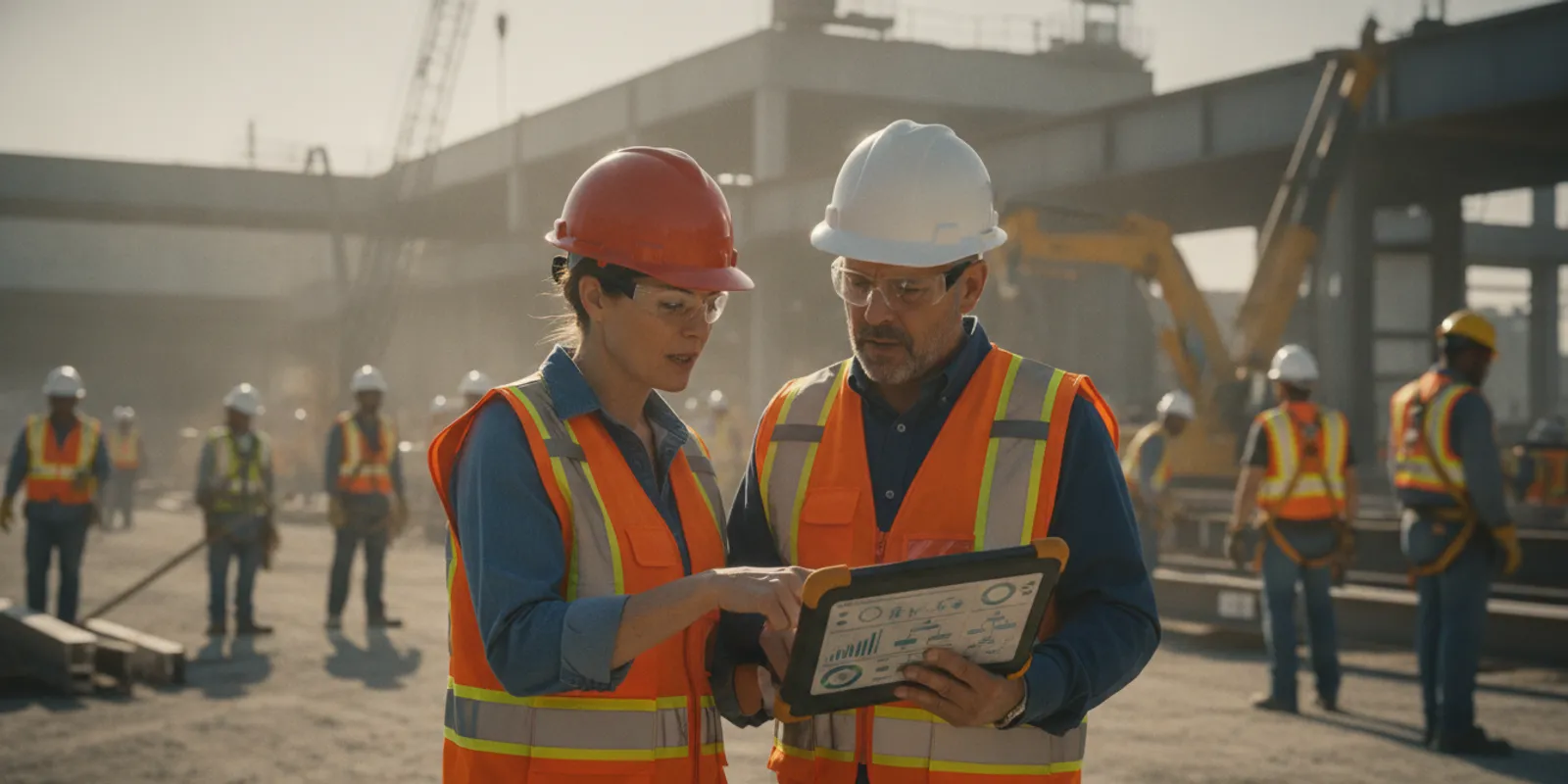
Workplace safety program development gives employers a repeatable way to identify hazards, reduce risk, and make safe work part of daily operations. For construction, oil and gas, manufacturing, transportation, and other high-risk employers, an effective program is more than a binder of policies. It connects leadership decisions, frontline input, training, inspections, and follow-up so people know what to do before conditions change or an incident occurs.
Discuss workforce safety and compliance support
What should a workplace safety program do?
A workplace safety program sets out how an organization will prevent injuries and illnesses, respond to hazards, and check whether its controls are working. It should explain who is responsible, how workers can raise concerns, what training is required, and how the employer will correct problems.
The exact content depends on the work. A construction contractor may need to coordinate multiple employers, changing work areas, and equipment. An oil and gas operator may need clear procedures for high-energy tasks, contractor interfaces, and remote locations. A manufacturer may focus on machine hazards, material handling, maintenance, and exposure controls. Each program should reflect the actual work and applicable requirements, rather than copy a generic template without review.
Keep the program usable. Employees and supervisors should be able to find the instructions they need, understand them, and apply them during the shift. Written procedures matter, but so do equipment, staffing, time, supervision, and a dependable way to report and resolve hazards.
How can leadership set the program up for success?
Visible leadership commitment is the starting point. Executives and owners set priorities through the resources they provide and the decisions they make when production pressures compete with safe work. Supervisors translate those priorities into daily expectations. Workers need a meaningful way to contribute and raise concerns without being ignored.
Begin with a written commitment that is specific to the organization. State that preventing harm is a management responsibility and that employees are expected to follow procedures, use required controls, and report hazards. Keep the message direct. A policy statement cannot replace operational decisions or legal duties, but it can establish the standard leaders intend to uphold.
- Name accountable roles. Identify who approves the program, who coordinates it, who supervises work, and who tracks corrective actions. Make clear that safety responsibilities sit with line management as well as any designated safety staff.
- Provide practical resources. Plan time for training, inspections, maintenance, and pre-task coordination. Confirm that needed tools, protective equipment, and competent support are available.
- Set expectations for supervisors. Explain how they should stop or pause unsafe work, respond to reports, and verify that corrections are complete.
- Make worker participation routine. Use safety meetings, toolbox talks, work planning, and accessible reporting channels to learn from employees who perform the tasks.
For a company with multiple facilities or contractors, define how local procedures fit the overall system. A central policy can establish minimum expectations, while site-specific plans address local hazards, emergency arrangements, and coordination with other employers. Review how those plans are shared before work starts.
How should employers assess hazards?
Hazard assessment is not a one-time exercise. Start by listing work activities, locations, equipment, materials, and groups of people who may be exposed. Include routine work and less frequent activities such as maintenance, startup, shutdown, deliveries, and emergency response. Consider contractors, temporary workers, and visitors where relevant.
Use several sources of information. Walk the site and observe tasks. Ask workers what changes, near misses, or difficult conditions they encounter. Review injury and illness records, incident reports, inspection findings, equipment manuals, and applicable regulatory requirements. For an introduction to a task-focused assessment, see this job hazard analysis guide. A job hazard analysis can be useful for examining a specific job, but it does not replace a broader program or an assessment of changing site conditions.
For each hazard, consider who could be harmed, how exposure could happen, and what factors make the risk more likely or severe. Examples include a worker being struck by moving equipment, exposure to hazardous substances, a fall from an elevated surface, or an unexpected release of energy during maintenance. A hazard list should lead to decisions, not just documentation.
Prioritize controls using the most effective feasible options first. Consider whether the hazard can be eliminated, whether a safer material or process can be substituted, and what engineering controls can isolate people from the danger. Administrative controls such as procedures and scheduling can help manage remaining risk. Personal protective equipment can provide an additional layer, but should not be treated as a substitute for stronger controls when those controls are feasible.
Record enough information to act: the hazard, affected tasks or areas, selected controls, responsible owner, and target date. Reassess when processes, equipment, materials, staffing, or work conditions change, and after incidents or reports reveal that the original assessment missed something.
How do you turn findings into a working plan?
Convert assessment findings into a prioritized action plan. Separate urgent hazards that need immediate attention from longer-term improvements. Assign each action to someone with authority and resources to complete it. Include a due date and a way to verify that the control works in practice.
A useful action item is specific. “Improve housekeeping” is difficult to verify. “Mark and keep the main pedestrian route clear at the loading area; the shift supervisor checks it at the start of each shift” gives people a defined action and a check. Adapt the level of detail to the risk and work setting.
Organize the written program so workers can find the parts they need. Depending on the operation, it may cover hazard reporting, safe work procedures, contractor coordination, protective equipment, emergency response, inspections, incident reporting, training, and records. Build from applicable legal requirements and recognized guidance, then tailor the procedures to actual jobs and locations. For industrial employers, the AMPP guide to developing an industrial safety program is one reference for structuring program development.
Do not let the written plan become detached from the work. Ask a supervisor and employees who perform the task to review proposed instructions. Confirm that the steps are understandable, tools and safeguards are available, and the procedure reflects how the job is actually done. If a control cannot be used reliably, find out why and revise the plan.
What training and communication should the program include?
Training should help people recognize hazards and perform their assigned work safely. Match the content to each role, task, site, and level of responsibility. New employees may need orientation before starting work. Experienced workers may need instruction when equipment, procedures, materials, or job assignments change. Supervisors need to know how to enforce controls, respond to reports, and escalate unresolved risks.
Use more than one format where appropriate. Short briefings before a task can reinforce specific controls. Demonstrations and supervised practice can help workers learn equipment or procedures. Written materials can support reference and consistency. Check understanding with questions or observation rather than assuming attendance means the worker can apply the information.
Keep a record of the training topic, date, participants, trainer or provider, and any assessment or follow-up required. Maintain a process for identifying overdue or missing training. The Texas Department of Insurance, Division of Workers’ Compensation provides safety and health training program descriptions that employers can review when planning training topics; confirm the current requirements that apply to your organization and work.
Communication should be two-way. Tell employees what hazards were found and what is being changed. Make reporting simple and explain who will respond. When workers raise an issue, acknowledge it, share the next step, and close the loop after action is taken. If a reported hazard cannot be corrected at once, explain interim protections and who is monitoring the situation.
How can inspections and maintenance prevent unsafe conditions?
Regular inspections can find damaged equipment, blocked access, missing guards, housekeeping problems, and other conditions before they contribute to harm. Set an inspection schedule based on the operation, hazards, equipment, and applicable rules. Identify what should be checked, who is qualified to check it, and how findings will be documented and corrected.
Pair planned inspections with ongoing observation. A checklist can improve consistency, but it should not limit inspectors to items on the page. Ask employees what has changed since the last check. Look at areas that are easy to overlook, including temporary work areas, storage, maintenance activity, and interfaces between vehicles and pedestrians.
Inspection results have little value if findings remain open. Categorize findings by urgency, assign an owner, set a due date, and track completion. For an immediate danger, take prompt steps to protect people and restrict access or stop the affected work as appropriate. Verify the repair or control before closing the item. Coordinate inspections with preventive maintenance, equipment checks, and contractor oversight where those processes apply.
Companies with dispersed crews may need a consistent way to share inspection records across sites. Keep enough detail to identify the location, issue, interim measure, final correction, and verification. Use recurring findings to identify whether a procedure, equipment choice, or training approach needs improvement.
How should employers respond to incidents and near misses?
Build a clear process for reporting and reviewing injuries, illnesses, property damage, near misses, and hazardous conditions. Respond first to immediate needs and make the area safe. Then gather information while details are available. Talk with people involved and witnesses, review the work conditions and procedures, and preserve relevant records or equipment when appropriate.
Focus on understanding how the event happened, not on finding someone to blame. Consider contributing factors such as unclear instructions, inadequate safeguards, equipment condition, workload, communication, supervision, or a change in the job. Ask whether the same conditions exist elsewhere. A review should lead to actions that address causes and reduce the chance of recurrence.
Assign corrective actions to responsible people and verify effectiveness. If the response is only a reminder to “be careful,” ask whether stronger controls are available. Share relevant lessons with other teams while protecting personal and confidential information. When reporting or recordkeeping rules apply, follow the requirements for the specific incident and jurisdiction.
Which program elements should employers compare and prioritize?
The following table is a planning aid, not a substitute for determining legal requirements. A smaller employer may combine roles, while a complex or multi-site organization may need dedicated owners for each area. The level of formality should match the hazards and scale of operations.
| Program element | What to establish | How to check it |
|---|---|---|
| Leadership and roles | Accountable leaders, supervisor duties, worker participation, and resources | Review responsibilities and confirm actions have owners |
| Hazard assessment | Methods to identify hazards, assess risk, and select controls | Review job and site assessments after changes or new findings |
| Training and communication | Role-based instruction, refreshers, reporting channels, and feedback | Check records and observe whether workers can explain and use controls |
| Inspections and maintenance | Inspection scope, schedule, maintenance, and hazard correction | Track findings to verified closure and review repeat issues |
| Incident learning | Reporting, review, corrective actions, and sharing lessons | Confirm actions address contributing factors and reduce recurrence |
| Program review | Measures, review frequency, and a process for updating the program | Document decisions, owners, and follow-up dates |
How can employers evaluate and improve the program?
Use both leading and lagging information. Lagging measures include injuries, illnesses, and other events that have already occurred. Leading measures can include hazard reports, inspection completion, training status, timely corrective actions, and worker participation. These indicators do not prove a program is effective by themselves. Use them to ask better questions and direct attention to weaknesses.
Review trends by location, task, equipment, and type of finding. A rise in reports may reflect improved trust and participation, not necessarily worsening conditions. Look at the context, ask workers and supervisors what they are seeing, and check whether controls are effective. Avoid setting targets that discourage honest reporting.
Schedule a program review at a defined interval and after important changes, such as a new process, new equipment, a serious incident, or a pattern of repeat hazards. Include leaders and people who do the work. Record what is working, what needs revision, who will make changes, and when the results will be checked. A workplace safety program should evolve as operations and risks change.
The MIT Sloan Management Review discussion of workplace safety and performance offers additional context on treating safety as part of operational practice. Employers should evaluate their own operations and requirements rather than assume one approach fits every workplace.
For employers coordinating occupational health and workforce compliance alongside safety procedures, review occupational health services and DOT compliance support as relevant to the workforce and applicable rules. Patriot also shares compliance insights and resources for employers planning workforce programs.
Talk with Patriot about your workforce compliance needs
Frequently asked questions
Is a written workplace safety program required?
Requirements depend on the work, industry, location, and applicable federal or state rules. Some standards require written plans or procedures for particular hazards or activities. Employers should identify the rules that apply to their operations and maintain documentation that meets those requirements. A written program is also a practical way to communicate responsibilities and keep processes consistent.
How often should a safety program be reviewed?
Set a regular review schedule, then review sooner when operations or hazards change, after an incident, or when inspections reveal recurring problems. The right interval depends on the work and applicable requirements. Do not wait for the scheduled review to correct an urgent hazard.
Who is responsible for workplace safety?
Leadership sets expectations and provides resources, managers and supervisors oversee work and controls, and employees follow procedures and report concerns. Safety professionals or coordinators can support the process, but responsibility should not be assigned only to one department. Define roles clearly for contractors and other affected parties as well.
What is the difference between a safety program and a job hazard analysis?
A safety program is the broader system for managing workplace risks, responsibilities, training, inspections, and improvement. A job hazard analysis examines the hazards and controls for a specific task. Employers may use task analyses as one input to the larger program, but they serve different purposes.
Effective workplace safety program development is a continuous management process: understand the work, involve employees, choose practical controls, and confirm that actions make a difference. When each part has a clear owner and follow-up, the program can support safer, more reliable work as conditions change.