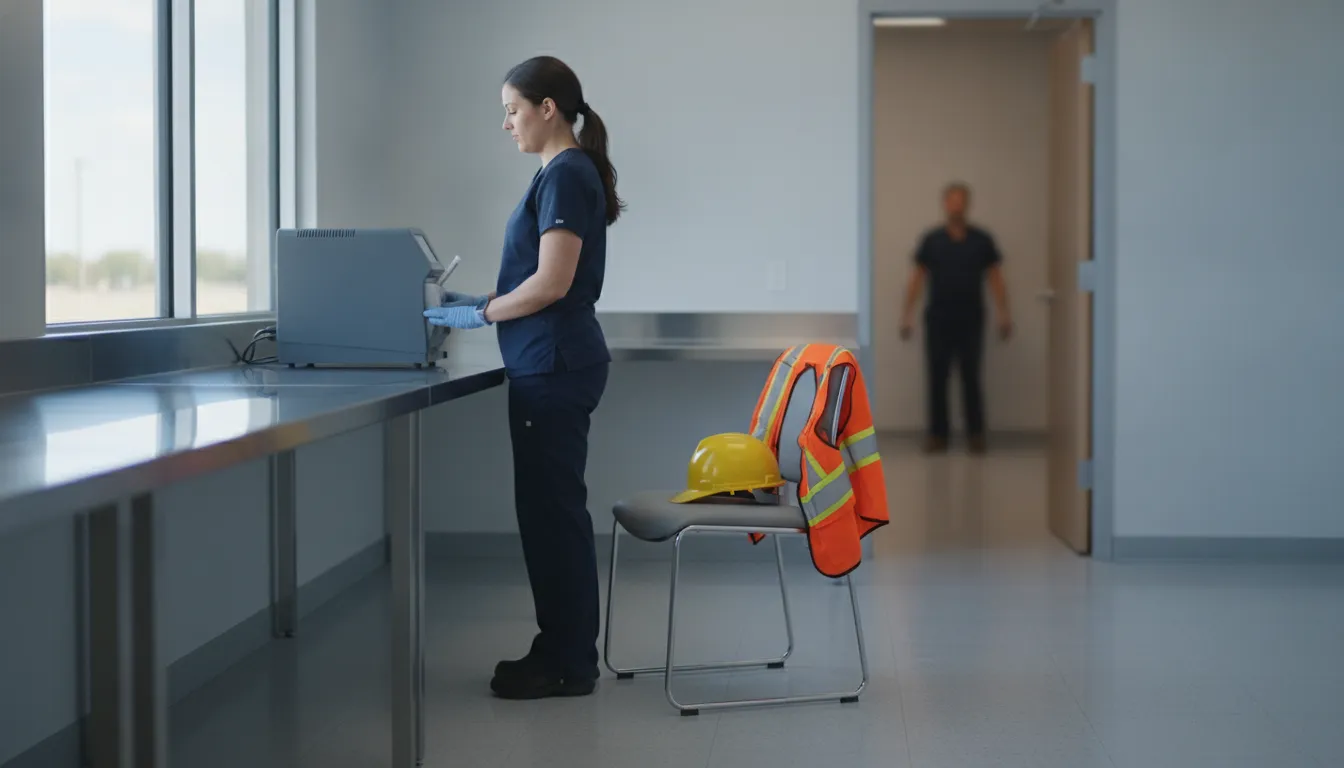
How does workplace alcohol testing work? It is a collection-day question, not a policy question. A trained technician checks identity, runs a breath screen, and stops if the result is under the level your written policy names. If the screen meets that level, the employee waits, then gives a confirmation breath on an evidential device. The technician records both results and sends them to the person your policy names. A urine drug test does not answer the same question, because alcohol leaves the breath as the body clears it. Employers who want that sequence run for them can start with drug and alcohol testing.
Call (432) 253-8958 to schedule alcohol testing
This page follows that sequence for a non-DOT employer that has already chosen breath testing. It does not tell you how to write a policy, which method to pick, or what a DOT cutoff requires. Those answers live on separate pages, and this one links to them when you need them.
How Does Workplace Alcohol Testing Work on Collection Day?
On collection day, testing is a short sequence. Confirm who is being tested, run a screening breath test, and send a confirmation test only when the screen meets the level in the written policy.
The person giving the test should be trained on the device in front of them. For DOT-covered work, that person is a Breath Alcohol Technician or a Screening Test Technician. A non-DOT employer can use a trained collector or a mobile technician. But the steps should still be written down so two supervisors do not run the test two different ways.
Alcohol testing is not the same event as a drug test. A drug test looks for drugs or their metabolites in urine, oral fluid, or hair. A breath alcohol test looks at alcohol in the air the person exhales right then. That is why the result is about current impairment, not about use last weekend. If both tests are ordered, do the alcohol test first. Alcohol can clear while the person waits for a urine collection.
- Confirm the test is authorized under the written policy and note the reason: random, reasonable suspicion, post-accident, or post-offer.
- Check a photo ID and match the name to the testing form before the device is used.
- Explain that the person should not eat, drink, smoke, or put anything in the mouth until the test is finished.
- Run the screening test on a device approved in your policy, in the person's presence.
- If the screen is under your policy level, stop, record a negative, and release the person.
- If the screen meets that level, start the waiting period and run a confirmation test on an evidential breath device.
- Show the person the result, complete the form, and send the result only to the designated employer contact.
The DOT screening rule in 49 CFR 40.247 is the clearest public write-up of those steps. It applies only to DOT-covered tests. Many non-DOT employers copy the same order because it is easy to defend: one screen, one wait, one confirmation, one record.
Who Is in the Room, and What Gets Checked First?
Only the employee and the technician need to be in the room, and the first check is identity, not the breath device.
A supervisor can drive the employee to the clinic or the mobile collector. The supervisor should not stand over the mouthpiece or discuss discipline during the test. Privacy matters here. The result is medical information about the person's current condition, and it should not be announced in a break room or a group text.
Before the first breath, the technician confirms a photo ID and writes the time. If the test is for reasonable suspicion, the supervisor's written observations should already exist. Those notes are separate from the testing form. The technician does not decide whether the supervisor was right to send the person. The technician runs the test the policy authorized.
Ask the employee, in plain words, not to eat, drink, smoke, or use mouthwash, gum, or tobacco until the process ends. Mouth alcohol from a recent drink, spray, or mint can raise a screening result that does not match alcohol deep in the lungs. Saying this before the test gives the employee a fair chance to comply. It also gives you a note on the form if they do not.
If the employee refuses to provide a breath, or leaves before the confirmation test, follow the refusal rule already in your policy. Do not improvise a new consequence at the clinic door. The workplace alcohol testing guide covers how to write that rule. This page only needs the collector to record what happened and the time.
What Happens During the Screening Breath Test?
The screening test is one breath into a prepared device. A result under the level in your policy ends the test. A result at or above that level leads to a confirmation test.
The technician opens a new mouthpiece in front of the employee, attaches it, and asks for a steady breath. The employee should be able to see the device. Hiding the screen or walking the device into another room makes a simple test look disputed later. When the device prints or displays a result, the technician reads it to the employee and writes it on the form.
For a DOT test, a screening result below 0.02 ends the process as negative. A result of 0.02 or higher requires a confirmation test. Those numbers are federal rules for covered transportation work. They are explained on the DOT alcohol testing cutoff levels page, including what 0.02 and 0.04 mean for duty. A non-DOT employer does not inherit those numbers automatically. Your policy should name the screening level you will use, and the collector should follow that page, not a number remembered from a DOT class.
An invalid screen is not a positive test. Low breath volume, a device error, or a broken mouthpiece means the screen did not produce a usable result. The practical step is to cancel that attempt, note the reason, and repeat the screen if the device and the person are still available. Do not treat a blank or error message as alcohol in the body.
When Is a Confirmation Test Required?
A confirmation test is required only after the screening result meets the level your policy, or DOT rules for covered employees, set as the trigger.
Confirmation uses an evidential breath testing device. It is not a second casual blow on the same screening stick. The DOT rule in 49 CFR 40.253 shows the device standard. It calls for an air blank in the employee's presence, a new sealed mouthpiece, a displayed result, and a printed result tied to that test. Non-DOT programs that want a result they can stand on should require the same kind of device for the confirmation. Even when Part 40 does not govern the employer.
The wait between the screen and the confirmation is usually 15 minutes, and not more than 30, on a DOT test. Use that window unless your own written procedure says something else. During the wait, the employee should not eat, drink, put anything in the mouth, belch, or leave the technician's sight. The wait lets mouth alcohol dissipate so the confirmation breath reflects alcohol from the lungs.
If the confirmation will happen at a second site, do not send the employee alone in their own vehicle. The screening result is already high enough to require a closer look. A second technician needs the screening form, the time of the first test, and a note that the waiting instructions were given. If the wait runs long because of travel, write the times down. A missing clock is what makes an otherwise clean test hard to explain.
| Step | What the technician does | What ends this step |
|---|---|---|
| Arrival. | The technician checks photo ID, the test reason, and the policy level. | The form has a name, a time, and a test reason. |
| Screen. | The technician uses a new mouthpiece and takes one screening breath. | The test stops as negative when the result is below the policy level. |
| Wait. | The wait starts only if the screen meets the policy level. | The wait is about 15 minutes with no food, drink, or mouth products. |
| Confirmation. | The technician uses an evidential breath device and a new mouthpiece. | The printed result is shown to the employee. |
| Handoff. | The technician completes the form and notifies the named employer contact. | The result stays off group texts and shared inboxes. |
How Should the Result Be Recorded and Shared?
The result goes on the testing form, the employee sees it, and only the designated employer representative receives it.
A complete form has the employee's name, the technician's name, the test reason, the device type, both times, and both results if a confirmation was run. If a printout exists, attach it. If the device stores the result electronically, the form should still name the test number. Later disputes are usually about missing times, not about the science of the device.
Tell the employee the number on the screen before they leave. Give them their copy of the form when your process provides one. Surprise is what turns a routine negative into a complaint. A confirmation result is the result you act on. Do not discipline from the screening number alone when your policy requires confirmation.
Send the result to one named contact, often called the designated employer representative in DOT programs. That person decides duty status, leave, and any next step the policy already lists. Coworkers, the job foreman, and a general HR inbox are the wrong audience. The OSHA memo on post-incident testing makes a related point: testing after an incident should look for causes, not punish someone for reporting an injury. Limit who sees the alcohol result for the same reason. A result that travels through a group chat stops being a safety record.
Keep the form long enough to match your policy and any DOT or state retention rule that applies. A non-DOT employer that has no set retention period should still pick one in writing. "We delete them whenever the folder gets full" is not a program.
How Is Non-DOT Testing Different From a DOT Test?
The breath steps can look the same, but a non-DOT employer sets the reason. The cutoff, and the consequence in its own policy, while a DOT employer follows Part 40.
DOT alcohol testing covers safety-sensitive transportation work under FMCSA, FAA, FRA, FTA, PHMSA, and the Coast Guard. If your driver or technician is in that program, use the DOT form, a qualified technician, and the federal levels. The DOT alcohol testing services guide walks through the five DOT test types. Do not mix a company-policy test and a DOT test on one form.
Everyone else follows the company policy and state law. That includes many oilfield, construction, and plant roles that feel safety-sensitive but are not DOT-covered. You can still require a breath test after an offer, for reasonable suspicion, after certain accidents, or on a random program where the law allows it. You choose the number that triggers confirmation. You also choose what a confirmed result means for the shift, the job, and any return-to-work step.
The ADA is the other limit. The EEOC's preemployment guidance says an alcohol test is a medical examination, and there is no exemption like the one for tests that look for current illegal drug use. An employer may not give that test before a conditional job offer. After the offer, or during employment, the test still has to fit the job and your written reason. A pre-offer application event is the wrong place for a breath test, even when a urine drug screen is allowed.
Texas employers should also read their own industry contracts. A pipeline or plant owner may require alcohol testing for site access even when DOT does not. Put that requirement in the policy and in the collection instructions, so the technician knows which form to use before the employee arrives.
What Should a Supervisor Do With the Result?
The supervisor follows the consequence already written in the policy. The collection site does not invent one.
If the screen was under the policy level, the person returns to work unless some other safety issue is still open. A negative alcohol test does not clear a separate fitness question, such as an injury from the same event. It only answers the alcohol question you ordered.
If the confirmation result meets the action level in your policy, remove the person from safety-sensitive work for that shift and start the step your policy names. That might be a ride home, a meeting the next business day, or a referral for assessment. Say which one in the policy before you need it. A roadside argument is a bad place to design a program.
Reasonable-suspicion tests need the observations that prompted the test. Keep those notes with the result, not in a separate notebook nobody can find. The reasonable suspicion testing guide covers what supervisors should document before they send someone. Alcohol testing works only when that front half already happened.
Do not promise a number you did not record. Employees will ask whether a single drink after a shift will fail tomorrow's test. Breath alcohol measures what is present at the test, not a history of drinks. Detection time depends on the amount, the person, and the clock. Your technician should not guess. Order the test when the policy says to, and let the device answer.
Where Does This Test Fit in a Larger Program?
The collection is one step inside a program that already names who gets tested, who collects, and who receives the result.
Employers that only need the collection can schedule on-site or clinic breath testing and keep the policy in-house. Employers that also run DOT panels, random selections, or several sites usually want one vendor to keep the forms. The technician qualifications, and the result routing in one place. Drug and alcohol testing at Patriot covers both DOT and non-DOT collections for that reason. The program manager, not the person at the mouthpiece, owns the decision to test.
If you are still deciding whether alcohol belongs on the same order as a drug screen, read the drug testing policy template beside your alcohol policy. The two programs share a designated contact and a privacy rule. They do not share a specimen, a cutoff, or a form. Writing them as one paragraph is how collections get ordered on the wrong paperwork.
Mobile collection changes the room, not the steps. A technician can meet a crew at a yard, but identity, a private space, a new mouthpiece, and a quiet handoff still have to happen. The mobile drug and alcohol testing guide covers how to set that visit up so the first person tested is not standing in a parking lot.
Frequently Asked Questions
Does a workplace drug test include alcohol?
Usually no. A standard urine drug panel does not measure current alcohol impairment. Alcohol testing is a separate breath test ordered on its own form. If you need both answers, order both tests and do the alcohol test first.
How long before the test should someone stop drinking?
There is no universal number of hours that clears every person. A breath test measures alcohol still in the body at that moment. The right employer question is whether the person is fit for the shift under the written policy, not whether a drink from last night has fully cleared.
Can an employer run an alcohol test before a job offer?
No. The EEOC treats an alcohol test as a medical exam. It has to wait until after a conditional job offer. A urine drug test for illegal drugs is different and can be part of hiring where the law and your policy allow it.
What if the screening test is positive but the confirmation is negative?
Act on the confirmation result. Mouth alcohol, a recent sip, or a product used just before the screen can raise the first number. That is why the wait exists. Do not apply the screening consequence when the evidential test does not confirm it.
Who is allowed to see the result?
The employee and the one employer contact named in the policy. Supervisors who need to know whether the person can return to a safety-sensitive task can be told the duty status. They do not need the form shared with the whole crew.
Talk with a testing specialist
Patriot Safety and Services has spent 14+ years and more than 230 projects helping employers run testing programs that hold up. If you want the collection steps, the forms, and the result routing set up for a non-DOT or DOT workforce, call (432) 253-8958.